
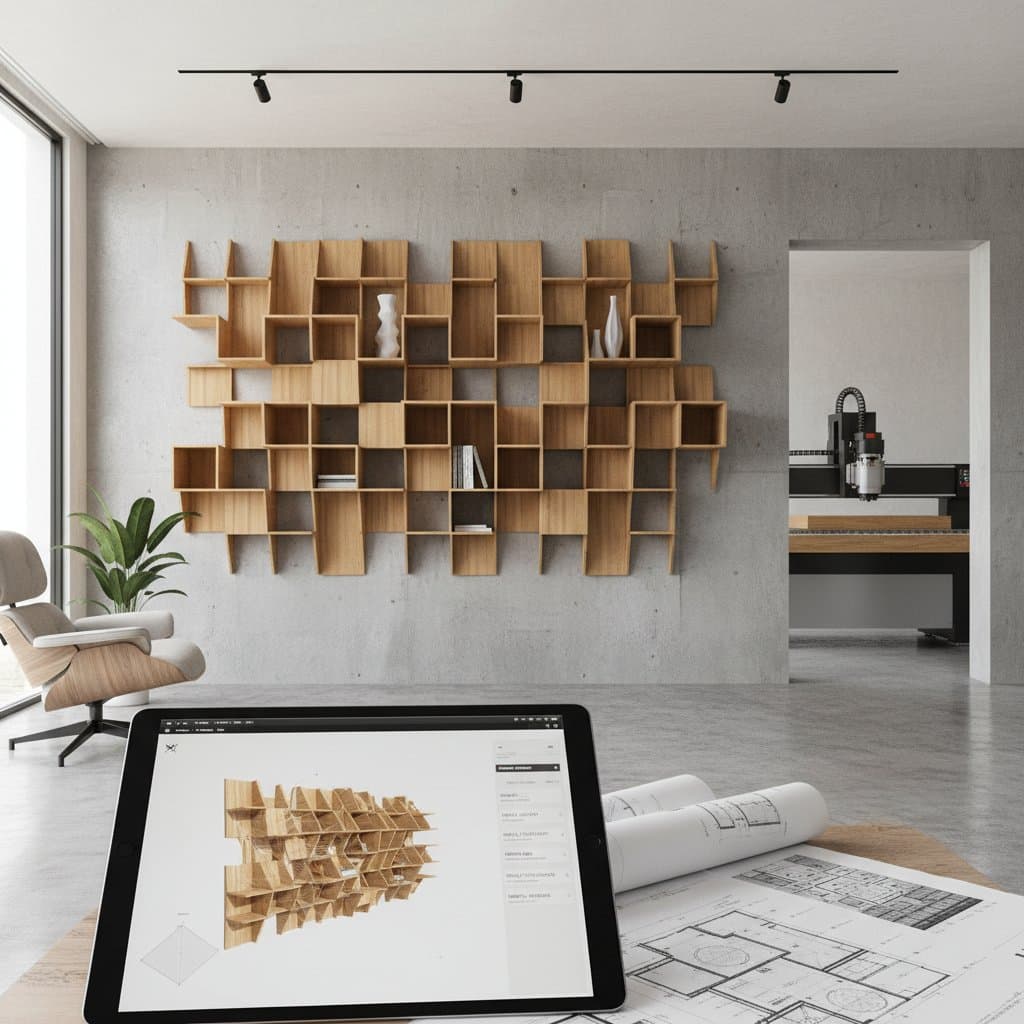
DIY Shelves Reimagined: The Power of Parametric Design
Custom shelving transforms the functionality of any room. Builders often encounter difficulties when fitting shelves into irregular spaces, such as walls with subtle bows, ceilings of varying heights, or corners that deviate from perfect squareness. These issues can extend a straightforward project into extended sessions of trimming and adjustments. Parametric design provides an innovative solution by allowing users to establish relationships and measurements within software, enabling the design to adapt automatically to dimensional changes. Once the rules are defined, the design manages itself efficiently.
Understanding Parametric Design for Woodworkers
Parametric design employs algorithms to define geometric forms. Woodworkers establish parameters including width, shelf spacing, and joint angles, then link them via rules. An adjustment to one value prompts automatic updates across the entire model. Software options such as Grasshopper integrated with Rhinoceros 3D, or accessible browser-based platforms like Shapr3D, enable sketching, testing, and refining of intricate shapes without the need to redraw individual components.
In a shelving project, this methodology allows for precise customization:
- Enter measurements for wall width, ceiling height, and required storage capacity.
- Produce a 3D model that refreshes immediately upon input of new dimensions.
- Generate accurate cut lists or files optimized for CNC machining.
Linking parameters eliminates uncertainty. The software computes uniform spacing, joint offsets, and material requirements. This approach delivers design versatility while preserving exactness.
Traditional plans constrain projects to rigid dimensions. In contrast, parametric rules maintain proportionality regardless of alterations in room size. Consider it akin to a master template that remains balanced under varying conditions.
To begin, establish a basic set of rules. Specify shelf height, thickness, and spacing intervals. Experiment by altering the overall width and observe the model's responses. With confidence in these foundational relationships, introduce greater complexity, such as curved elements or interlocking joints.
Budget Considerations for Parametric Shelving Projects
Parametric shelving accommodates a range of budgets, influenced by material choices and fabrication techniques.
Entry-Level Option ($180 to $300):
- Utilize plywood sheets with manual cutting methods.
- Employ tools like a handheld router or circular saw for shaping.
- Focus on straightforward rectangular configurations to minimize complexity.
Intermediate Option ($350 to $550):
- Select Baltic birch or maple-veneered plywood for enhanced durability.
- Engage a CNC cutting service to achieve precise joints and clean edges.
- Incorporate features such as integrated lighting or subtle curves for added appeal.
High-End Option ($600 to $900 and beyond):
- Opt for solid hardwood panels to ensure longevity and aesthetic richness.
- Include custom hardware and concealed fasteners for a seamless finish.
- Explore advanced patterns or modular systems that allow future expansions.
Allocate approximately 10 percent of the total budget for unforeseen adjustments or errors. While parametric precision minimizes material waste, expenses for finishing supplies and hardware accumulate quickly.
Prioritize quality in core materials; steer clear of inexpensive plywood prone to voids. Such defects lead to compromised joints and subpar edge finishes. Choose smooth, stable panels to guarantee reliable outcomes throughout the build.
Avoiding Pitfalls in Parametric Shelving Construction
Adopting parametric design introduces unique challenges, though most prove preventable with foresight. Below are frequent issues encountered by builders, along with strategies to mitigate them.
- Excessively Complex Rule Sets: An overload of interconnected variables can destabilize the model. Limit initial efforts to three or four essential parameters, such as overall width, height, and number of shelves.
- Neglecting Material Thickness: Failure to parameterize thickness results in inaccurate spacing. Always integrate this factor to ensure automatic adjustments when switching between material types.
- Omitting Tolerance Verification: Variations in CNC machine performance necessitate testing. Fabricate a small sample joint to validate fit prior to processing full panels.
- Overlooking Load-Bearing Capacity: Shelves exceeding 36 inches in length risk sagging under weight. Incorporate central supports or increase material thickness for items like books or tools.
- Inadequate Finishing Strategy: Intricate parametric curves often create dust-collecting crevices. Sand components thoroughly before assembly to facilitate easier maintenance.
Addressing these concerns upfront streamlines the process and fosters a dependable workflow. Experienced builders report that early testing halves revision time on subsequent projects.
Personalizing Your Parametric Shelves
Beyond technical execution, parametric shelves foster a distinctive design vocabulary in the workshop. A single parameterized pattern scales effortlessly across applications, from entryway storage cubbies to comprehensive office wall systems. Defined parameters enable variations in mere minutes, rather than prolonged hours of redesign.
Consider stylistic expressions to align with personal taste:
- Modular Grid Layouts: Ideal for minimalist environments, these provide clean lines and flexible arrangements.
- Organic Wave Forms: These sculptural elements add artistic flair, transforming functional pieces into focal points.
- Asymmetric Configurations: Such designs introduce visual dynamism, functioning as integrated wall art.
Enhance with practical additions like LED strips recessed within shelves or veneers in contrasting tones to accentuate contours. The digital nature of parametric modeling supports realistic renderings of finishes and lighting effects prior to fabrication, reducing the risk of dissatisfaction.
Parametric design emphasizes control over complexity. Builders dictate which elements adapt and which remain constant, yielding furniture that integrates seamlessly with both space and individual style. This method not only fits irregular architectures but also elevates everyday storage into enduring, bespoke creations.
Essential Resources for Parametric Woodworking
To deepen proficiency, explore software tutorials tailored to woodworking. Grasshopper offers free beginner modules focusing on parametric basics, while Shapr3D provides intuitive interfaces with community-shared shelving templates. For hardware inspiration, review catalogs of concealed hinges and adjustable brackets that complement adaptive designs.
Visual aids prove invaluable: Sketch initial concepts on graph paper before digitizing, and use screen captures from your model to document parameter changes. Online forums dedicated to CNC woodworking share real-world case studies, illustrating how parametric techniques resolve common spatial challenges. These tools and insights empower builders to refine skills and innovate confidently.