
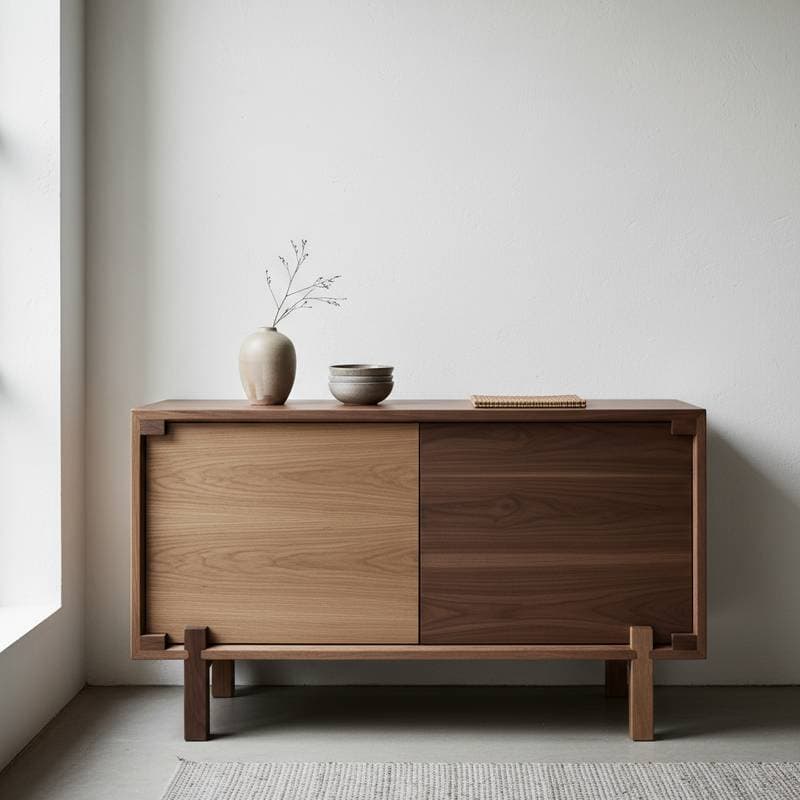
Fusing Japanese Precision and Scandinavian Utility in Woodworking
Japandi joinery integrates the meticulous accuracy of Japanese woodworking traditions with the functional elegance of Scandinavian aesthetics. This approach yields designs that appear timeless yet innovative. Woodworkers benefit by concentrating on precise alignments, wood grain patterns, and balanced dimensions, eschewing decorative excess. Such methods demand attentiveness and deliberation, resulting in furnishings that develop character through use and foster environments of composure.
At a Glance
Style Focus: Japandi, minimalist fusion, joinery-centric design
Core Materials: White oak, ash, walnut, maple
Typical Projects: Dining tables, entry benches, wall-mounted cabinets
Design Teams Cited: Kuroki Studio, Nord Form Design
Photography: Mika Ito, Erik Lunde
Challenges in Traditional Approaches
Woodworkers frequently seek streamlined silhouettes but produce items that appear overly austere or industrially fabricated. Factory-made pieces conceal hardware and imperfections under consistent laminates. Erik Lunde, a Scandinavian furniture artisan, noted, "I wanted warmth without clutter." The difficulty lay in constructing items that maintain apparent simplicity while disclosing their underlying framework.
Frequent issues encompass apparent hardware, wobbly connections, and coatings that lose luster prematurely. The goal involves achieving robustness without excess mass, allowing the assembly method to serve as the primary aesthetic element.
Benefits of the Japandi Approach
Japandi joinery addresses these concerns through restrained visuals paired with transparent construction. Consider a low-profile oak console table where joints remain visible yet meticulously finished. Legs connect to the apron via half-lap joints that align seamlessly, with edges rounded by hand for subtle refinement. The tabletop rests on modest oak dowels, forming a subtle shadow gap. These techniques minimize perceived heaviness while enhancing joint integrity.
Artisans at Kuroki Studio characterize this as "elevating joinery to decorative status." Images reveal equilibrated dimensions, illumination grazing beveled edges, and uninterrupted grain flow across components. The effect conveys steadiness and endurance, evoking a sense of permanence.
Essential Design Elements
Joinery Techniques
- Dovetail keys secure corners and introduce rhythmic patterns.
- Mortise and tenon assemblies stabilize legs without relying on metallic hardware.
- Bridle joints form airy structures ideal for open shelving or seating.
Material Selection
- Light-toned woods like ash and birch maintain an open, breathable aesthetic.
- Subtle walnut highlights provide restrained depth.
- Plant-based oils enhance wood texture without obscuring its natural character.
Proportion Guidelines
- Aprons on tables position approximately 10 inches (25 centimeters) from the edge to accommodate comfortable legroom.
- Cabinet depths measure about 16 inches (40 centimeters) to preserve spatial openness.
Finishing and Illumination
- Satin sheens diffuse light gently and accentuate surface details.
- Integrated LED lighting beneath shelves highlights suspended elements.
Storage Solutions
- Tambour-style sliding panels minimize required swing space.
- Drawers with shallow depths of roughly 3 inches (7.5 centimeters) organize essentials efficiently.
Each choice contributes to overall equilibrium. No element dominates; instead, the interplay of wood, connections, and negative space narrates a tale of moderation and skill.
Practical Implementation Steps
1. Establish Proportions First.
Sketch outlines that evoke serenity prior to any cuts. Japandi designs favor reduced elevations and extended lengths. For instance, position a coffee table at 14 inches (36 centimeters) tall to promote relaxed, low seating arrangements.
2. Highlight Joint Visibility.
Expose connections rather than concealing them, transforming them into central features. Such displays underscore the artisan's involvement and the reliability of full-thickness wood.
3. Apply Contrast Judiciously.
Incorporate a single darker element amid lighter fields. Multiple hues can fracture the serene cadence essential to this style.
4. Direct Lighting with Purpose.
Allow ambient light to skim surfaces softly, avoiding harsh reflections. Pair ceiling sources with ambient side illumination to draw attention to wood figuring.
5. Prioritize Durability.
Select coatings amenable to maintenance. Hand-applied oil permits localized renewal without full refinishing. Precisely executed joints accommodate adjustments or re-adhesion as required.
Integrating into Daily Spaces
Adopting Japandi joinery in the workshop instills a discipline of selectivity. Every incision serves a function, whether for ergonomic ease or seamless visual progression. This philosophy permeates living areas, promoting uncluttered and stable interiors. A walnut dining table featuring angled legs facilitates unhurried gatherings. An entryway birch bench remains narrow but resolute, deterring accumulation.
Owners frequently observe shifts in routines. Lin Mei, reflecting on her Japandi-influenced kitchen island, shared, "We started putting things away right after use." The unadorned profiles demand maintained clarity, naturally cultivating orderly habits.
Sources and Credits
Design Teams: Kuroki Studio, Nord Form Design
Photographers: Mika Ito, Erik Lunde
Japandi joinery transcends fleeting styles, focusing on furnishings that endure physically and resonate personally. The deliberate act of interlocking wood components cultivates forbearance. Gradually, surfaces acquire a soft sheen, joints enrich in tone, and surroundings reflect intentional artistry.