
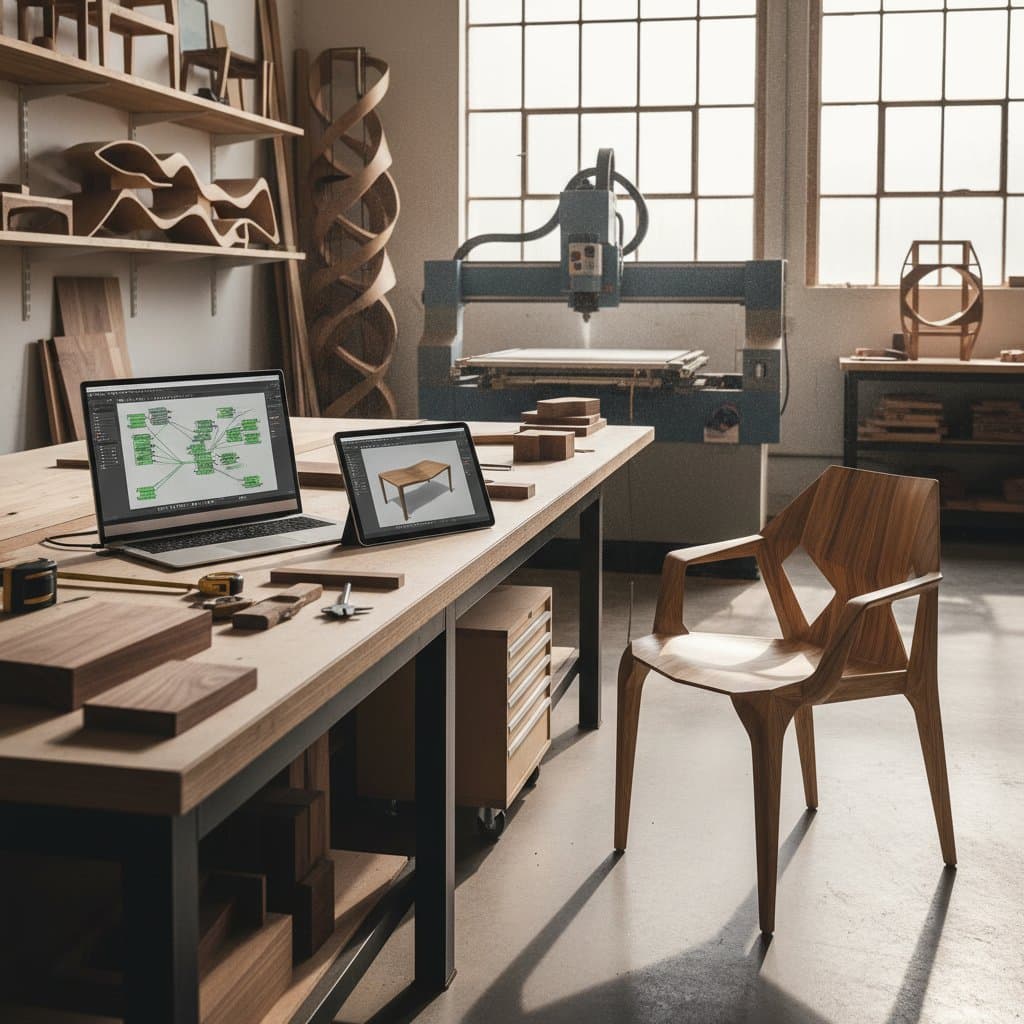
Parametric Tools Revolutionize Custom Wood Designs
A single adjustment to a digital model can now transform an entire furniture piece in seconds. Parametric design software converts hours of manual drafting into swift, seamless modifications. Woodworkers accustomed to relying on intuition and visual estimation may find this transition invigorating yet challenging. Those who master these tools achieve precision and creative latitude that surpass conventional techniques.
At a Glance
Average Software Cost: $250 to $1,200 per seat
Learning Curve: 20 to 40 hours for basic proficiency
Output Accuracy: Within 0.01 inch of CNC specifications
Best For: Custom furniture, architectural millwork, and batch production
What Parametric Design Means for Woodworkers
Parametric design employs variables such as length, angle, and material thickness to generate a model that adjusts automatically upon any alteration. Rather than redrawing variations manually, designers establish interconnected relationships. Increasing seat height by two inches, for instance, prompts immediate adaptations in legs, supports, and joinery.
Software options including Grasshopper for Rhino, Fusion 360, and SolidWorks bring this capability to small operations. Users link mathematical formulas to geometric elements, specify material tolerances, and evaluate joinery durability prior to cutting wood. Such features cut waste and preserve labor hours valued at $60 to $120 each.
Consider a chair modeled in Grasshopper: it generates ten variants suited to diverse body types in minutes. Balance and structural soundness persist across changes, thanks to embedded mathematical definitions.
Action Step: Select a repeatable item, like a stool or shelf unit. Develop a parametric model permitting independent adjustments to width and height. Observe the resulting workflow flexibility.
How Parametric Models Improve Production
Conventional woodworking depends on static templates. Parametric modeling substitutes these with dynamic digital rules that revise automatically. This method pairs effectively with CNC routers or laser cutters, as design files transfer directly to manufacturing.
Principal advantages include:
- Consistency: All components adhere to uniform geometric principles.
- Speed: Modifications that previously required hours happen instantaneously.
- Efficiency: Material nesting algorithms optimize layouts to reduce scrap.
- Integration: Files export seamlessly to CAM systems, yielding accurate toolpaths.
A modest furniture workshop might halve setup durations after assembling a parametric parts library. This shift allocates more effort to artisanal details and finishing, away from repetitive drafting.
Action Step: Measure the duration required to modify a design manually in your existing process. Replicate the alteration using a parametric model. Note the time savings, often shifting from hours to minutes.
Costs and Budget
Launching parametric workflows demands modest outlays, far below enterprise scales. Essential components comprise:
- Software: $250 to $1,200 for commercial licenses
- Training: $300 to $800 for virtual or on-site sessions
- Hardware: $1,000 to $2,500 for suitable computing equipment
- Add-ons: $100 to $400 for extensions or visualization modules
Initial expenditures typically range from $1,650 to $4,900. These sums recoup rapidly through fewer errors and accelerated project bids in custom work.
Accessible alternatives abound. Grasshopper integrates with Rhino, and discounted educational versions exist. Fusion 360 provides free tiers for qualifying small enterprises. The primary investment involves dedicated learning time rather than licensing expenses.
Money-Saving Tip: Initiate with a solo license or trial edition. Upon validating alignment with operations, upgrade to multi-user access.
DIY or Professional Integration
Self-directed learning suits parametric modeling, though optimal strategies vary by objectives.
When DIY Makes Sense
Solo proprietors or design enthusiasts in compact custom shops benefit from independent study. Abundant online guides and forums address essential skills. Allocate 20 to 40 hours to grasp parameter connections, material designations, and CNC-export preparation.
When to Hire a Specialist
Expanded studios or assembly lines frequently engage parametric experts to construct foundational templates. Such professionals convert legacy designs into flexible frameworks at $60 to $100 hourly. They manage transitions to CNC execution and verify tool compatibility.
Hiring Checkpoints:
- Confirm proficiency in Grasshopper or Fusion 360.
- Review examples featuring modifiable parameters.
- Insist on receiving modifiable originals, beyond mere outputs.
- Validate comprehension of woodworking connections, extending past basic CAD forms.
Action Step: For teams new to CAD, commission a freelancer for an initial parametric template. Adapt it internally thereafter. This combined method controls expenses while upholding precision.
Common Mistakes to Avoid
Parametric software offers substantial power, yet novices risk setbacks without forethought. Sidestep these pitfalls:
- Absent parameter documentation. Unlabeled variables breed disarray. Catalog all driving dimensions clearly.
- Excessive complexity. Interlinked elements overburden systems. Initiate with straightforward constructions.
- Overlooking physical properties. Screen-perfect joints may falter in dense woods. Prototype to confirm.
- Inadequate versioning. A disrupted reference risks total model failure. Archive iterations consistently.
- Disregarding equipment constraints. Certain contours or dimensions challenge specific machinery. Account for operational boundaries.
These errors demand corrective hours. A flawed model might necessitate full reconstruction. Maintain organized frameworks and cross-check via tangible trials.
Action Step: Draft a parameter inventory prior to construction. Incorporate measurement standards, allowable variances, and linked elements. This practice averts propagating faults.
Building and Maintaining Your Parametric Library
With a established parametric collection, revisions flow with ease. Alter a single directive, like thickness or surface treatment, to overhaul product ranges. This adaptability equips modest workshops to rival industrial scale.
Key Takeaways:
- Begin modestly. A single model demonstrates tangible benefits.
- Document systematically. Maintain parameter guides for each creation.
- Test promptly. Confirm virtual concepts through wood samples.
- Remain engaged. Tools advance steadily, with fresh extensions emerging regularly.
Next Steps for Implementation:
Choose an established furniture design from your repertoire. Rebuild it parametrically. Experiment with variable tweaks to assess structural impacts. Upon approval, generate manufacturing paths for CNC or laser equipment.