
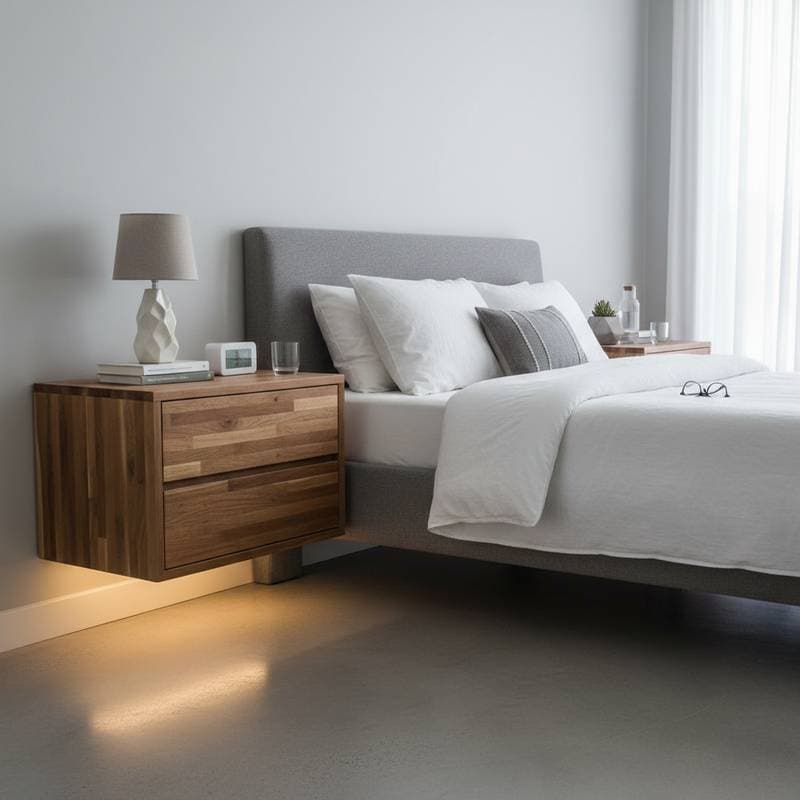
Create Space-Efficient Floating Nightstands at Home
Floating nightstands offer a practical solution for bedrooms where space constraints demand innovative furniture choices. These wall-mounted units, constructed for $60 to $180 per pair based on material selections, provide the appearance of bespoke cabinetry. Basic tools, precise measurements, and reliable wall anchors enable completion within a weekend. The installation yields additional floor area, improved organization for electrical cords, and a streamlined modern aesthetic suitable for diverse interior schemes.
Benefits of Choosing Floating Designs
Conventional nightstands often contribute to a sense of overcrowding in compact sleeping areas. Wall-mounted alternatives attach directly to the structure, exposing the floor beneath and creating an illusion of expanded dimensions. This visibility facilitates easier maintenance tasks, such as vacuuming, while allowing concealment of wiring and accommodation of under-shelf storage options like woven baskets.
Such designs align with contemporary ideals of reduced visual noise. They direct focus toward central elements like the bed and ambient illumination, avoiding the dominance of substantial pieces. In elongated or narrow configurations, where spatial efficiency proves essential, these units excel. Typical freestanding models measure 24 inches in width by 18 inches in depth; floating versions permit customization to 14 inches in depth while preserving utility.
Consider sketching the proposed arrangement on paper. Position markings for the bed frame, then determine heights of 24 to 28 inches from the floor to ensure ergonomic access.
Material Costs and Selection Options
Expenses vary according to choices in lumber and fixtures. Anticipate the following breakdowns:
- Plywood or pine planks: $25 to $40 for components serving two units
- Premium options such as oak or walnut: $70 to $120
- Fastening hardware and structural anchors: $10 to $20
- Finishing products including stain, protective coatings, and application tools: $15 to $25
Professional fabrication incurs $250 to $450, encompassing supplies and workmanship. Independent construction halves this expenditure. Resourceful individuals often repurpose residual wood from prior endeavors, reducing outlays below $50.
Opt for straightforward rectangular forms devoid of compartments to minimize hardware needs and maintain a tidy profile. Allocate resources toward surface treatments, as exposed areas influence the overall impression most significantly.
Essential Construction Steps
Assemble the nightstands through a sequence of measured preparations and secure assemblies. Begin by selecting boards cut to dimensions of 24 inches wide, 14 inches deep, and 8 inches high for the primary shelf. For added stability, incorporate a 1-inch-thick cleat spanning the width, notched to align with wall studs.
Cut plywood using a circular saw guided by a clamped straightedge for precision. Sand edges smooth with 120-grit paper, progressing to 220-grit for a refined texture. Apply wood glue along joint seams, then secure with 1.25-inch brad nails driven at 45-degree angles to prevent splitting.
Mounting requires locating studs with an electronic detector, spacing units 2 to 4 inches above outlets for cord access. Drill pilot holes and insert heavy-duty toggle bolts or lag screws rated for 50 pounds each. Test levelness with a 4-foot spirit tool before final tightening.
Finishing involves two coats of oil-based polyurethane, applied with a foam brush and allowed 4 hours drying between layers. Buff lightly with 320-grit sandpaper for a satin sheen. Total build time spans 6 to 8 hours, excluding drying periods.
Pitfalls to Sidestep During Installation
Appearances of simplicity belie potential complications impacting aesthetics and structural integrity. Address these concerns proactively:
- Overlook verification of wall supports. Fasteners without stud engagement frequently yield under applied forces.
- Permit inconsistencies in elevation. Disparities as small as one-quarter inch become evident upon placing fixtures like reading lamps.
- Exceed capacity limits. Restrict loads to 25 pounds per side absent supplementary bracing.
- Ignore provisions for wiring. Determine positions for power sources and illumination prior to fixation.
- Select incompatible surface treatments. Evaluate stain shades alongside existing furnishings under low-light conditions to ensure harmony.
Environmental factors warrant attention as well. Unprotected solid lumber risks dimensional shifts from moisture fluctuations. Seal all faces uniformly with a durable topcoat to mitigate such effects.
Integrating and Maintaining Your Nightstands
Once installed, these pieces enhance daily routines through versatile applications. Position bedside essentials such as books or remotes on the shelf, utilizing adhesive clips behind the unit for cord routing. In larger rooms, vary depths to 16 inches for accommodating larger items without compromising the floating effect.
Seasonal adjustments prove straightforward. Refresh finishes annually with a light sanding and recoat to preserve vibrancy. For evolving tastes, repaint in neutral tones like soft gray to complement shifting decor themes.
The enduring value lies in sustained spatial freedom and customized appeal. Homeowners report heightened satisfaction from clutter-free environments that promote restful atmospheres. Experiment with underlighting strips for subtle glow, transforming functional storage into ambient features.