
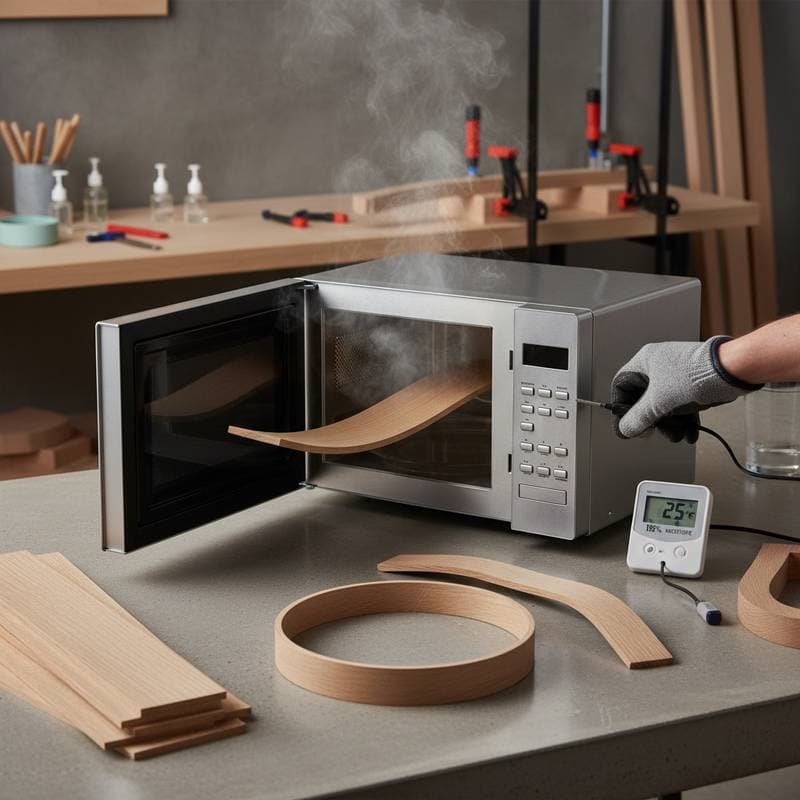
Microwave Wood Bending: A Fast Alternative to Steaming for Smooth Curves
Woodworkers often face the challenge of creating elegant curves without investing hours in traditional steaming setups. A microwave offers a practical solution by softening wood fibers through targeted internal heating. This approach delivers consistent bends for components like chair backs or drawer fronts, all within a compact workshop space.
The process relies on exciting water molecules within the wood to generate steam, which relaxes the rigid lignin structure. As a result, thin strips conform to forms rapidly and retain their shape upon cooling. Professionals and hobbyists alike appreciate this method for its efficiency and minimal equipment needs.
Principles Behind Microwave Wood Bending
Microwaves agitate water molecules deep within the wood, producing steam that plasticizes the lignin binder among fibers. This internal softening allows the material to bend without external moisture saturation. Upon cooling in a form, the wood sets firmly, minimizing spring-back compared to prolonged steaming.
Conventional steam bending involves enclosing wood in a vapor-filled box for 30 to 60 minutes, demanding significant space and setup time. In contrast, microwave heating completes the process in under ten minutes for most pieces. The technique suits small-scale production where precision matters more than volume.
Advantages of This Method
- Internal heating distributes warmth uniformly, reducing the risk of uneven bends.
- Moisture control remains straightforward through periodic rehydration during cycles.
- The setup requires no dedicated infrastructure, ideal for home or mobile workshops.
Begin with kiln-dried stock reconditioned to 20 percent moisture content. Enclose the piece in a damp paper towel or a perforated plastic bag to retain humidity and avoid charring. Apply heat in brief intervals to build pliability gradually without drying the surface.
Investment and Setup Costs
The microwave bending system proves economical for entry-level users. A reliable countertop microwave ranges from $80 to $120, sufficient for workshop demands. Construct bending forms from medium-density fiberboard or scrap plywood at a material cost of $20.
Additional items like adjustable clamps and straps contribute $20 to $40. Traditional steam systems, by comparison, surpass $400 with their boilers, enclosures, and plumbing. Hobbyists save substantially by repurposing household appliances and offcuts.
Practical economies include sourcing a used microwave from secondary markets and fabricating forms with basic tools. Select analog models over digital for precise timing control during short bursts.
Pitfalls and Prevention Strategies
Excessive heating risks charring the exterior or fracturing internals; halt cycles at the onset of any aroma or discoloration, then reapply moisture. Always test pliability by hand rather than relying solely on time.
Disregarding grain orientation invites longitudinal splits; inspect boards under bright illumination and align bends parallel to the growth rings. The heartwood side should face the inside of the curve for enhanced compression tolerance.
Omitting a sturdy form results in asymmetrical shaping; improvise with layered plywood laminates secured by screws if custom jigs prove unavailable. Patience during the cooling phase prevents distortion; premature removal leads to partial reversion.
Maximizing Durability in Bent Components
Successful microwave bending yields components that withstand everyday use when properly finished. Apply sealers like polyurethane to protect against humidity fluctuations that could induce warping. Integrate bends into designs with supportive joinery, such as dovetails or mortise-and-tenon connections, to distribute loads evenly.
Test finished pieces for resilience by simulating handling stresses. This ensures longevity in applications from cabinetry to musical instruments. With repeated use, the method becomes a staple for efficient curve creation without compromising quality.
Supporting Resources
Incorporate visuals to aid comprehension:
- A labeled diagram illustrating the microwave enclosure, including damp wrapping and internal placement.
- Sequential photographs of the clamping process on a sample form, highlighting strap tension and alignment.
These elements clarify execution for novice users while reinforcing best practices for all.