
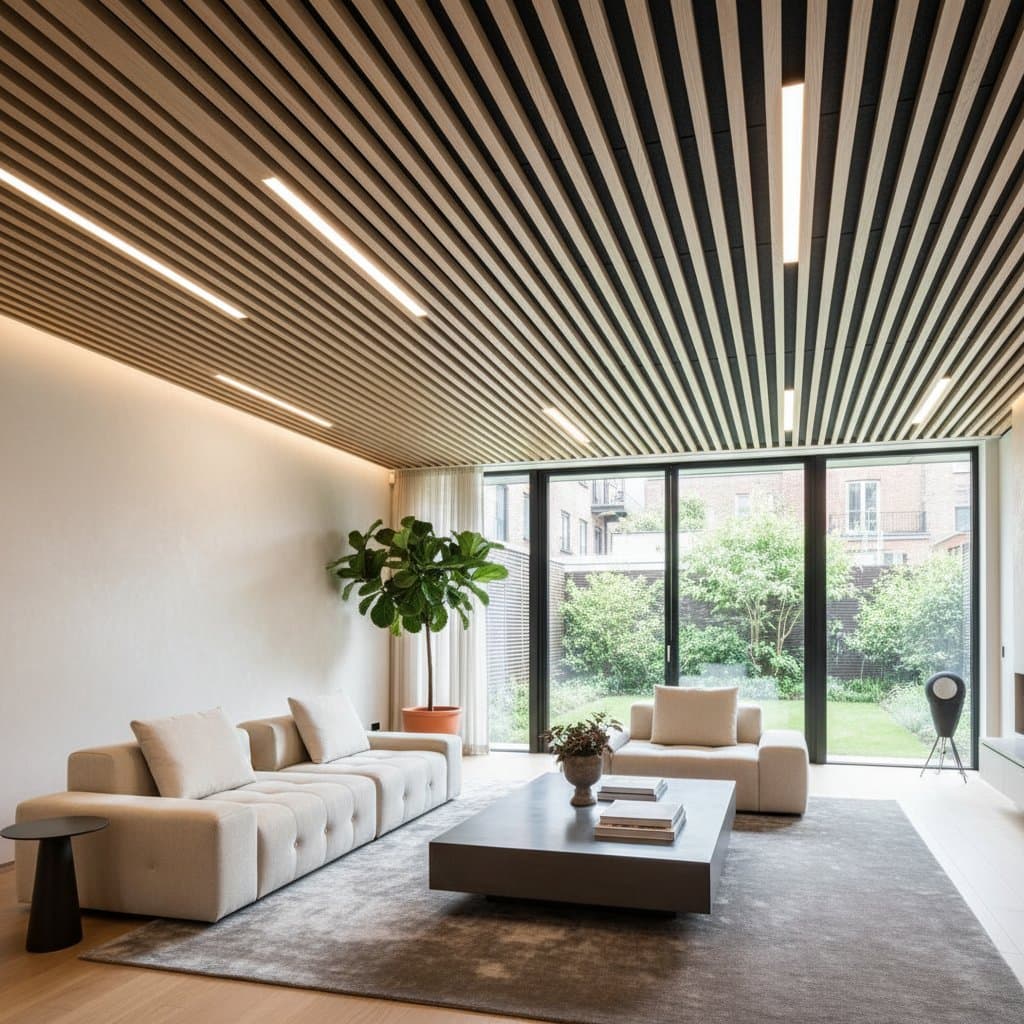
The DIY Ceiling Solution for Sound Control and Visual Appeal
Noisy environments disrupt comfort in even the most thoughtfully designed homes. Hard surfaces amplify echoes from footsteps and conversations, leaving spaces feeling stark and incomplete. Builders and DIY enthusiasts increasingly turn to the acoustic batten ceiling, a system that dampens sound while introducing organic warmth through wood elements.
This guide details the mechanics of a wood slat ceiling supported by acoustic panels. It addresses planning layouts, selecting components, and adapting the design to match specific room acoustics and aesthetics.
Project Overview
Target Audience: Homeowners seeking improvements in acoustics and interior style
Suitable Locations: Living rooms, home studios, open-concept kitchens
Scale: Effective in areas from 100 square feet (9.3 square meters) to 600 square feet (55.7 square meters)
Inspiration Sources: Projects from independent carpenters and acoustic interior specialists
Visual Documentation: Images from contributing project teams
Existing Conditions
Standard drywall ceilings dominate many homes, reflecting sound waves and creating persistent echoes. In open floor plans, noise migrates freely between areas, diminishing privacy and focus. Visually, these surfaces appear plain and uninviting, especially under harsh recessed lighting.
Typical challenges encompass:
- Reverberation caused by rigid floors paired with smooth overhead planes
- Lack of spatial separation in multifunctional zones
- Stark appearance from unpainted or basic white finishes
One homeowner noted, “We enjoyed the layout, but every discussion or film viewing resonated like an empty hall.”
Transformed Results
Installation of an acoustic batten ceiling yields noticeable improvements in both auditory and visual qualities. Slender wood battens align parallel across the surface, separated by acoustic fabric or panels that capture sound energy. The wood introduces depth and natural tones, softening the room's overall palette.
Photographs highlight how the linear pattern directs gaze upward, fostering a sense of height and unity. Integrated LED lighting nestles within gaps for diffused illumination, while pendant fixtures suspend from reinforced points, with wiring concealed behind the structure. The result conveys serenity and intentional design.
Interior specialist Carla Nguyen shared, “Our installation featured white oak battens at one inch (2.5 centimeters) thickness over black acoustic felt. This setup provides visual anchoring and reduces echo by approximately 50 percent.” Her group assessed performance with a portable sound level meter, recording a decline from 72 to 56 decibels amid typical speech levels—a subtle yet perceptible enhancement.
Technical Specifications
Materials and Configuration
- Wood battens in solid or veneered form, measuring one by two inches (2.5 by 5 centimeters), positioned with three-quarter-inch (1.9 centimeter) gaps
- Backing of acoustic felt panels or mineral wool insulation
- Furring strips or mounting cleats to secure battens uniformly, incorporating airspace for optimal absorption
- Matte surface treatments to minimize reflective glare
Lighting Considerations
- Continuous LED tape lights embedded in batten intervals for even distribution
- Electrical boxes positioned above the acoustic layer for discretion
- Dimmable systems enabling adjustable ambient levels
Assembly Guidelines
- Snap a chalk line to delineate batten paths across the ceiling
- Employ a custom jig or spacer to ensure uniform intervals
- Apply finish to battens prior to installation to prevent overhead mess
- Incorporate a one-inch (2.5 centimeter) perimeter clearance for shadow detailing and material accommodation
Acoustic Effectiveness
- Pair with floor coverings and soft furnishings for comprehensive noise management
- Targets flutter echoes prevalent in hard-surfaced environments
- Performs reliably on ceilings reaching up to ten feet (3 meters) in height
Essential Strategies
1. Define Acoustic Objectives
Assess whether the focus lies on isolating a single area or enhancing whole-home sound quality. Coverage of 60 to 70 percent of the ceiling surface often suffices for residential settings. In expansive layouts, concentrate battens over key interaction or work zones.
2. Select Appropriate Wood Types
Opt for lighter woods such as ash or maple in low-light rooms to reflect natural brightness. Deeper options like walnut or tinted pine provide grounding contrast. Engineered alternatives or sealed plywood suit moisture-prone areas. Maintain uniform batten dimensions for balanced diffusion.
3. Conceal Structural Flaws
The batten system masks exposed wiring, minor fissures, or irregular drywall seams. Acoustic backing allows future access to services without disassembly. Route any new cabling through protective conduits ahead of batten attachment.
4. Manage Illumination and Contrast
Batten alignment generates dynamic linear shadows that evolve with sunlight. Blend embedded lighting with selective pendants for versatile mood control. Set LED placement roughly two inches (5 centimeters) from the backing surface to eliminate bright spots.
5. Simplify Upkeep
Surface dust on battens wipes away easily using a microfiber tool or gentle vacuum attachment. Select darker backing fabrics to hide incidental soiling. Apply a transparent matte sealer to wood elements for resistance against humidity and discoloration.
Underlying Principles
Audio waves propagate and rebound off planar surfaces, intensifying room noise. The batten design interrupts this cycle by interspersing rigid wood with absorbent materials, dissipating energy on contact. A modest two-inch (5 centimeter) depth delivers quantifiable reductions in reverberation time.
This approach merges craftsmanship with performance, rivaling traditional millwork at a fraction of the expense. Moderate carpentry proficiency enables completion. Homeowner Luis Ortega observed, “The living area now resembles a fresh renovation. Normal speech volumes suffice, and the overhead wood enhances perceived scale.”
Customization Options
Budget-conscious or temporary installations benefit from modular panels: affix battens to felt-lined plywood substrates for wall-like suspension. Industrial spaces like workshops favor raw pine with clear finishes for practical luminosity. Elevated aesthetics emerge from combining walnut battens, deep gray backing, and metallic fixtures.
Daily Integration
Post-installation, the ceiling subtly reshapes room dynamics. Dialogue remains clear without residual ring. Audio playback achieves equilibrium across frequencies. The patterned overhead element unifies adjacent areas while inviting vertical appreciation, delivering enduring value to inhabitants.