
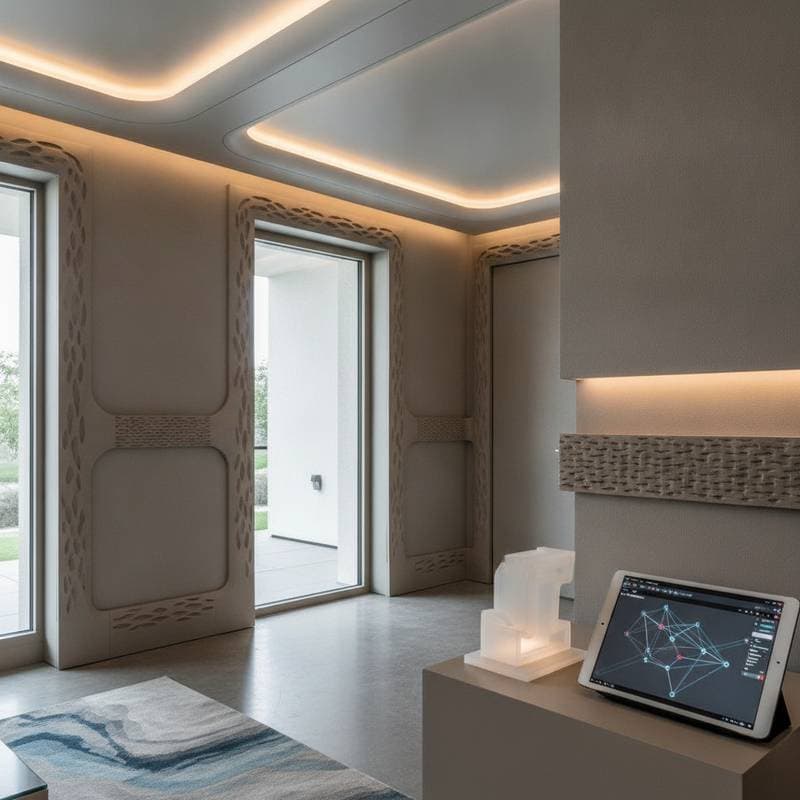
3D-Printed Trim Revolutionizes Custom Interior Molding
Replacing traditional trim once meant choosing between stock profiles or paying for expensive custom millwork. With 3D printing that tradeoff fades. Homeowners, builders, and designers now create custom interior molding with near-zero waste and precise repeatability. The process blends parametric design, modern materials, and digital fabrication.
At its core, 3D-printed trim offers two advantages old methods cannot match. Complete design freedom and on-demand production stand out. Whether the goal is ornate crown molding that matches a historic villa or sleek geometric lines for a minimalist loft, the needed profile prints exactly when required.
How 3D Printing Transforms Trim Production
Traditional molding relies on knives and cutters to carve profiles into wood or composite stock. Each pattern requires its own tooling. This adds cost and limits flexibility. With 3D printing the design exists as a digital file. The printer builds the shape layer by layer without special tooling.
Parametric design software plays a major role. Designers define relationships between dimensions, curves, and decorative elements. Changing one measurement adjusts the entire model automatically. A single trim style therefore generates in dozens of variations to fit different rooms or ceiling heights.
3D-printed trim reduces waste because only the needed volume of material is used. Offcuts and sawdust disappear. The process also supports recycled and biodegradable materials. This makes the method attractive for sustainable building projects.
Ask your designer or fabricator whether they can produce parametric models for your trim. This approach eliminates costly redesigns later.
Why It Works for Custom Design
Parametric modeling makes it possible to match any architectural style. Proportions and motifs adjust instantly whether the target is Greek Revival detailing or contemporary wave patterns. This flexibility solves one of the biggest frustrations in renovation. Inconsistent trim sizing in older homes no longer creates problems.
A parametric file adapts to uneven walls or nonstandard ceiling heights. The printer generates each section precisely. Installers report saving 20 to 40 percent of fitting time compared with traditional molding.
Digital libraries now store thousands of profiles. Designers select a base shape, tweak it, and preview the result in augmented reality before printing. This reduces guesswork and client dissatisfaction.
Request a digital preview or sample print before committing to a full run. Confirmation of scale and pattern accuracy follows.
DIY or Professional Printing
A mid-size printer with at least a 300-millimeter bed and basic CAD skills allows trim to be printed at home. One spool of filament yields around 25 linear feet of small trim. Larger crown or baseboard sizes require segmented prints joined with adhesive.
Confirm the printer supports the chosen material. Use a 0.4-millimeter nozzle for detail or a 0.6-millimeter nozzle for faster output. Print segments no longer than 24 inches to avoid warping. Sand lightly with 220-grit paper before priming. Join sections using solvent or mechanical connectors.
Printing a full room of trim can take several days of continuous operation. Professional services remain the better option when time or quantity matters. A commercial shop produces 100 linear feet overnight using multi-head printers.
Hire a pro when consistent color or surface finish is needed across many rooms. Integrated LED channels or concealed wiring paths also call for professional equipment. Complex geometry or deep relief patterns belong in the same category.
Ask for sample prints and references when vetting a fabricator. Confirm use of industrial-grade printers and quality-controlled materials. Reliable providers maintain moisture-controlled filament storage and calibrated machines.
Durability and Maintenance
Printed trim holds up well indoors when sealed correctly. PETG and ABS resist moisture and minor impacts. PLA performs best in temperature-stable spaces. Expect an indoor lifespan of 10 to 25 years depending on exposure and finish quality.
Maintenance stays straightforward. Clean with mild soap and water. Avoid harsh solvents. Repaint when scuffs appear. A cracked piece reprints identically from the original file.
Every section remains digital. Homeowners therefore maintain a permanent archive of trim profiles. Future repairs or expansions become effortless.
Store digital files in a cloud folder labeled by room and profile type. Quick reprints follow if any section needs replacement.
Integrating Functional Elements
3D printing enables trim to serve new functions. Designers embed LED lighting channels, acoustic dampening textures, and cable routing paths directly into the molding profile. Integration streamlines installation and removes the need for secondary materials.
Parametric design tools allow these functional elements to adjust automatically with size and curvature. The result merges aesthetics and utility in a unified design.
A printed baseboard can include a removable channel for low-voltage wiring. Crown molding can diffuse indirect light through translucent resin. These features add high-end appeal at a fraction of custom millwork cost.
Discuss how lighting or wiring might integrate into the trim during layout planning. Early coordination ensures proper print geometry and electrical safety.
Long-Term Care
Once installed, printed trim requires minimal upkeep. Cleaning and periodic paint touch-ups form the main tasks. Avoid heat guns or abrasive pads during refinishing. Use adhesive rated for plastic if a piece loosens. Nails or screws can crack the surface.
The digital nature of every profile keeps replacements simple. A complete archive supports ongoing maintenance without repeated fabrication delays.