
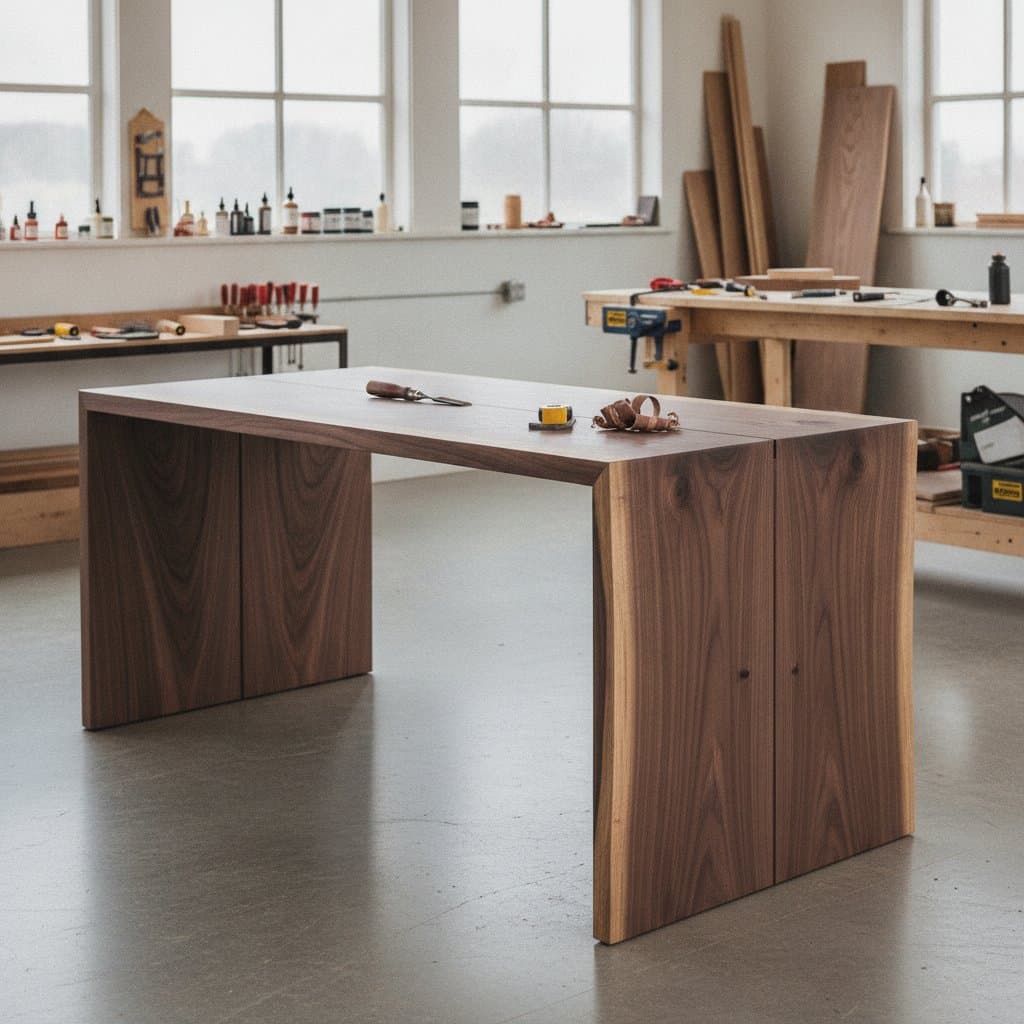
Walnut Waterfall Edges Transform DIY Tables Into Sculpture
Walnut waterfall tables draw attention in workshops and online communities. They combine sculptural presence with joinery that remains practical for experienced makers. A continuous grain that flows across the edge turns a flat surface into a three dimensional form.
This approach creates visual unity between the top and supports. The result feels both modern and organic.
Why the Design Appeals to Makers
Earlier DIY tables often paired slab tops with metal legs. The combination delivered function yet lacked cohesion. Separate frames interrupted the eye and left the surface feeling disconnected from its base.
A mitered waterfall joint solves that problem. The grain continues without interruption, producing a single visual line that reads as one piece of wood folded into shape. The technique demands care during layout and cutting, yet it stays within reach of most equipped home shops.
Refined Design Elements
Materials
- Solid walnut slabs 1.5 inches thick
- Clear matte hardwax oil to retain natural color
- Tinted epoxy for filling small voids when needed
Joinery and Structure
- Full length 45 degree miters at the transitions
- Hidden splines or dominoes for reinforcement
- Joint alignment held to 1/32 inch tolerance
Lighting and Display
- Undermount LED strips to wash light along the inner corner
- Overhead fixtures that highlight grain direction
- Neutral backdrops that increase walnut contrast
Storage and Function
- Slim drawers mounted beneath the top for desk versions
- Concealed cable ports on the underside
- Recessed glides or felt pads to protect floors
These choices produce a piece that appears substantial while remaining visually light.
Step by Step Construction
Select and Prepare the Slab
Choose a walnut slab wide enough for the planned top. Flatten both faces with a planer or router sled. Square the ends. Fill any knots or checks with tinted epoxy before final sanding.
Plan Grain Flow
Mark the cut so the grain will wrap continuously over the miter. Lay the slab flat and use painter tape to indicate top and side orientations before cutting.
Cut Accurate Miters
Use a track saw or table saw with a long fence to produce clean 45 degree angles. Test the fit so the two pieces form a true 90 degree corner. Dry fit the assembly before applying glue.
Reinforce the Joint
Insert dominoes, biscuits, or a spline roughly 1/4 inch deep. Reinforcement resists shear and keeps the corner tight under load.
Glue and Clamp
Apply slow set epoxy or polyurethane glue. Use band clamps or corner blocks to maintain even pressure. Confirm that the outer joint line stays invisible.
Sand and Finish
Sand through 220 grit. Apply a clear matte hardwax oil to bring out depth without gloss. Heavy polyurethane finishes can give walnut an artificial appearance.
Add Final Hardware
Install adjustable feet or felt pads. For desks, route a small power grommet through the underside of the top.
When finished, the table should appear as though the slab folded naturally, with grain lines running unbroken from top to side.
Design Variations
A single waterfall desk suits home offices where one side meets a wall. The drop adds visual weight without reducing legroom.
A double waterfall dining table works as a balanced centerpiece in open spaces. Both ends remain visible and symmetrical.
A narrow console version, roughly 14 inches deep, fits behind a sofa or along an entry wall. Mixed material versions pair walnut with oak or ash side panels, or add a thin brass inlay along the miter for contrast.
All versions rely on the same principle of grain continuity across the fold.
Visual Examples
Studio images show a dining table where diagonal light accentuates the corner. The grain travels without break from top to leg. A subtle LED strip inside the knee space casts a warm wash along the floor.
Another example features a single waterfall desk against a white wall. The miter disappears completely under the matte finish. A notebook and cup rest on the surface, illustrating calm utility.
Practical Takeaways
- Plan cuts so grain flows naturally over the corner.
- Hold alignment to 1/32 inch to preserve the visual effect.
- Use a clear matte oil finish to reveal texture without plastic sheen.
- Adapt the form to desk, dining, or console scales while keeping the core move consistent.
- Employ side or low level lighting to emphasize fluid grain.
Daily Use and Care
A walnut waterfall table serves as a stable anchor in daily routines. Its monolithic shape simplifies cleaning and reduces visual clutter. The surface invites touch and resists passing trends.
Wipe regularly with a soft cloth. Reapply hardwax oil once or twice a year to maintain protection. Avoid harsh cleaners that can dull the natural tone. With routine care the piece retains its warmth and structural integrity for decades.