
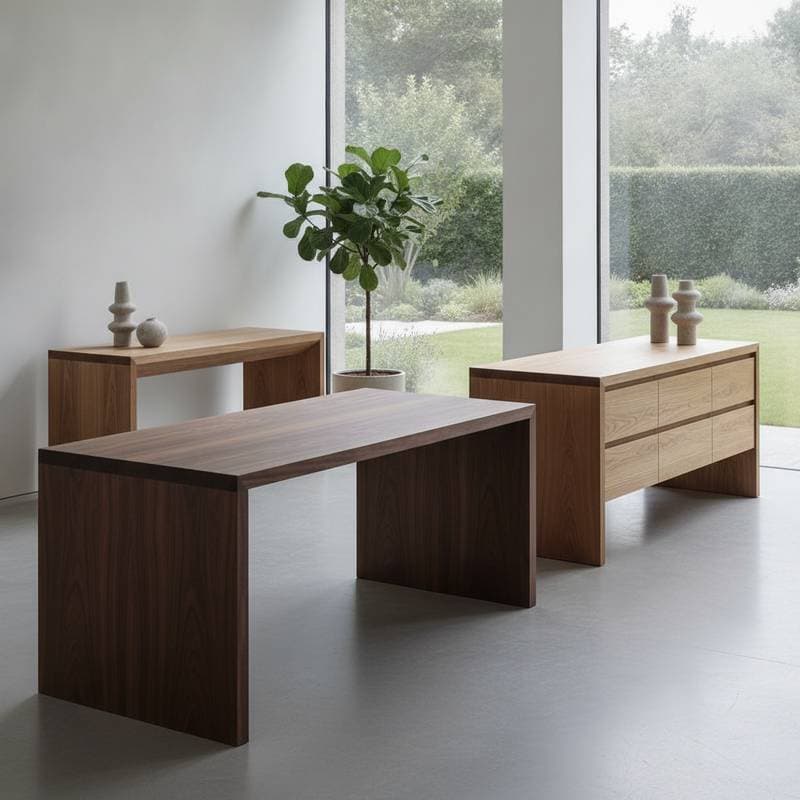
2026's Hottest Furniture Trend: Seamless Waterfall Edges
The clean mitered corner has returned with greater precision. The seamless waterfall edge, once limited to kitchen islands and gallery pieces, now shapes how makers present solid wood and veneer as one continuous surface. Grain flows from top to side without interruption. This approach delivers sculptural calm that feels both crafted and current.
The trend reflects growing interest in restraint and longevity. Makers invest extra time in milling, glue up, and finishing to keep natural material visible rather than concealed.
Core Elements at a Glance
- Trend centers on seamless waterfall edges.
- Continuous grain meets invisible joinery at mitered corners.
- Common uses include tables, vanities, desks, cabinetry, and shelving.
- Success depends on precise cuts and careful grain matching.
- Leading practitioners include custom studios and high end millwork shops.
Reasons the Technique Matters Today
Minimalist rooms now favor warmth and honest materials over stark surfaces. A waterfall edge maintains crisp lines while letting wood speak through unbroken planes. The effect suits walnut, white oak, maple, and sequenced veneer alike.
Cabinetmaker Luis Ortega notes that clients seek furniture that feels calm yet distinctive. A waterfall corner achieves this through the cut itself rather than added ornament.
The method also supports careful material use. Sequenced veneer or matched boards reduce waste and maintain visual continuity from one surface to the next.
Origins and Recent Refinements
The waterfall profile first appeared with stone slabs in modern kitchens. Woodworkers adopted the idea and shifted focus from contrast to seam invisibility. Joints grew tighter and glue lines thinner as tools improved.
Sliding table saws and track routers produce reliable forty five degree cuts with little tear out. Vacuum presses allow veneer to wrap corners cleanly. Smaller shops can now reach quality levels once limited to large facilities.
Consistency across a room has become simpler. A dining table can share the same edge detail as a nearby console, creating deliberate spatial harmony.
Defining Characteristics
- Grain runs continuously across the corner like fabric.
- Mitered faces meet at forty five degrees and glue into a ninety degree edge.
- Sanding and finishing eliminate visible glue lines; some makers tint epoxy for an exact match.
- Splines or biscuits placed every eight inches keep the joint stable.
- Edges stay flush to preserve the single block appearance.
Common Applications
Dining and coffee tables gain presence when the top reads as one slab. Kitchen islands clad in wood reach the floor with softened lines. Vanities appear grounded even when mounted clear of the floor. Tall shelving units lose visual weight through mitered corners. Desks and benches acquire a carved, custom quality.
Workshop Process
Board selection starts the sequence. Makers choose straight grained stock long enough to span top and sides. After planing, cuts are laid out in order. A fine tooth blade on a sliding table saw produces the miters. Dry fitting confirms alignment before glue up. Painter tape or corner clamps hold the joint during curing.
Light hand sanding follows. The goal is to soften the transition without rounding the edge. Hard wax oil or low sheen polyurethane then deepens color while protecting the surface.
Designer Mariah Kim observes that the highest praise comes when viewers assume the piece is solid wood, meaning the joint has disappeared.
Practical Details
Rift sawn white oak and black walnut pair well with matching edge treatments. Domino tenons or hardwood splines reinforce the corner. Finishes such as hard oil or matte lacquer maintain clarity. Concealed LED strips can accent the plane. Stable humidity and mild cleaning protect the joint over time.
Walnut Table Project
Ortega Studio replaced a laminate desk with a seventy two inch walnut table featuring waterfall sides. Continuous grain guides the eye downward. A concealed cable trough keeps the surface clear. Three coats of natural oil provide a durable finish. The client described the table as a permanent room element rather than temporary furniture.
Oak Vanity Project
Finch and Row Millwork created a floating oak vanity with mitered panels. An integrated LED channel produces a soft glow along the lower edge. Rift white oak veneer over plywood keeps weight manageable while the continuous grain suggests a single block. Three inches of clearance beneath aids cleaning.
Maple Shelving Project
Studio North Joinery installed a ten foot maple unit with mitered corners at every junction. Vertical and horizontal members share continuous grain. Concealed pins support adjustable shelves. The pale matte lacquer and slim profile make the tall unit feel lighter than its actual size.
Implementation Points
Accurate setup prevents gaps that break the illusion. Boards or veneer sheets from the same log ensure seamless transitions. Reinforcement every eight to ten inches maintains long term stability. Quiet finishes preserve natural texture. Strategic under lighting draws attention to the edge without glare.
Daily Care and Adaptation
The profile suits rooms that value calm geometry and natural texture. It works with stone, glass, or matte walls in both minimalist and warmer settings. Keep humidity between forty and fifty five percent. Address small dents with wax filler rather than heavy sanding. The same technique scales from side tables to full architectural millwork.