
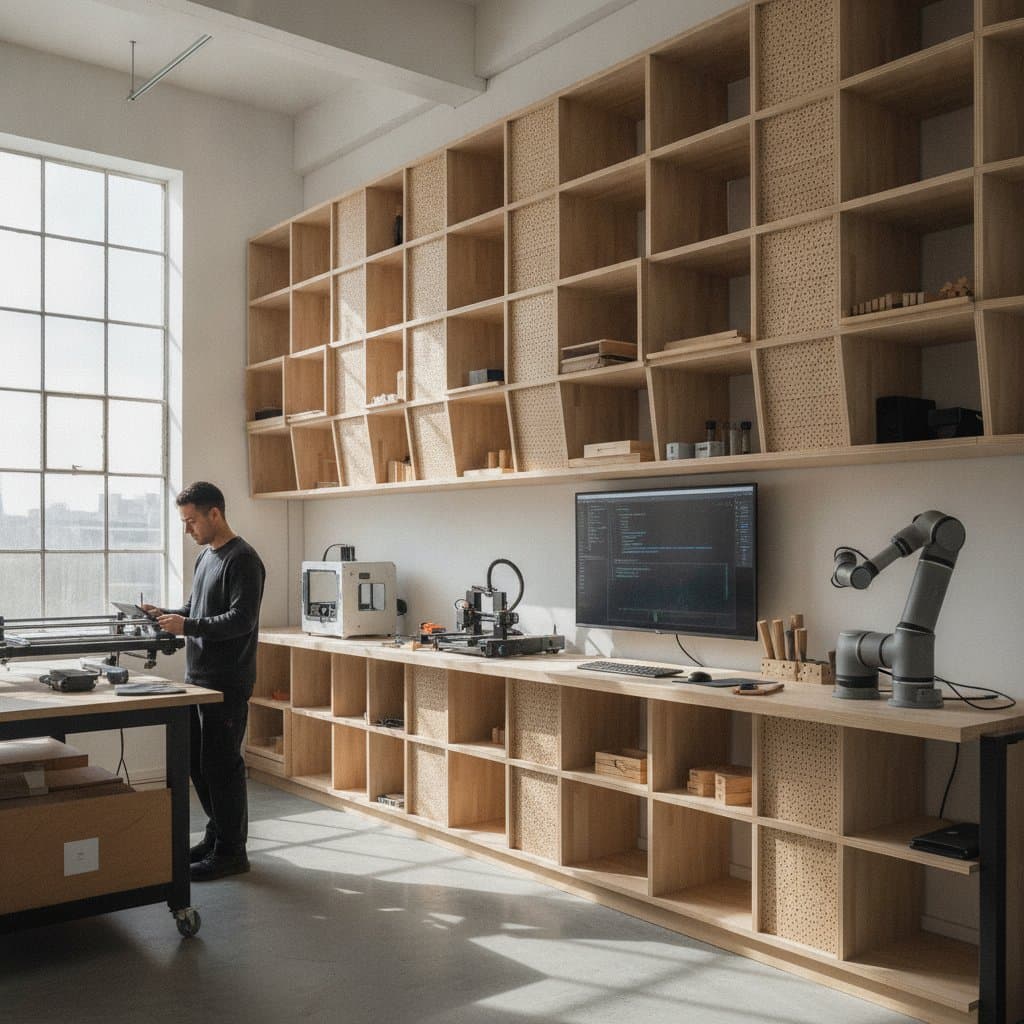
From Code to Craft
Ortiz developed the shelving script in Grasshopper, the visual programming tool connected to Rhino 3D. Sliders in the script adjusted shelf thickness, joint overlap, and overall curvature so that one change updated the full layout. She described the process as collaborative: the program becomes a partner. The designer shapes rules rather than drawing every shelf by hand.
Carver Works faced the task of turning those digital curves into durable wood joints. Lead fabricator Jonah Perez explained that a five axis CNC handled the initial cuts, yet final fitting required clamps and hand planes. Wood moves with changes in humidity while algorithms remain fixed, so every script must include tolerance values that account for real material behavior.
Flexible Layouts That Stay Coherent
The system accepts any wall length as input and produces updated cut files automatically. Homeowners can rerun the script later when their book collection grows, and each new version retains the same proportional relationships. This approach eliminates repetitive redrafting while preserving a consistent design language across every iteration.
Parametric methods therefore replace the rigid grid of modular units with families of related forms. Instead of identical rectangles, the shelves follow shared spacing and depth rules that create visual rhythm without uniformity. Builders gain freedom to adjust overall width or depth while the underlying order stays intact.
Readers who want to try similar work should first list priorities such as maximum book capacity, display zones, or wall rhythm. Those goals become the targets the script optimizes. Clear objectives prevent the geometry from drifting into decoration without purpose.
Lighting Integrated from the Start
LEDs placed behind each shelf lip deliver graze lighting that reveals wood grain without glare. The script calculated shelf spacing to keep brightness consistent from top to bottom, something difficult to achieve with manual drawings. Morning light reaches the upper shelves first and shifts the oak tones from pale gold to deeper amber as the day progresses.
Homeowner Eli Chen noted that the wall now functions as both storage and a soft ambient source for evening reading. The lighting layer was defined early so fixtures aligned exactly with the final geometry rather than being added afterward.
Practical Guidelines
- Define relationships first. Set rules for spacing, load, and sight lines before modeling any individual part.
- Iterate in the digital model. Small slider movements quickly show how proportion changes the overall feel.
- Allow for material movement. Build tolerance into joints, especially on wide panels that respond to seasonal humidity.
- Plan lighting within the script. Link fixture locations to shelf positions so wiring and mounting stay coordinated.
- Reserve handwork for refinement. Let the algorithm manage repetition while edges, joints, and finishes receive attention at the bench.
Daily Experience in the Loft
The completed shelves anchor the concrete interior and draw the eye upward through alternating dense and open zones. Negative space between book clusters provides visual rest while the continuous grain offers warmth. Chen observed that the installation feels alive because the underlying math remains visible yet subordinate to the character of the wood.
Ortiz summarized the approach by noting that code serves as another tool and that craft ultimately decides the result. The same balance of rule and judgment that guides traditional joinery now operates at a larger scale, giving woodworkers precise control over complex assemblies without replacing the final hand finishing that makes each piece belong in its space.