
Mycelium Furniture: Growing Materials Instead of Cutting Them
The next wave of sustainable furniture may not come from a sawmill or factory but from a living organism. Mycelium, the root network of fungi, is proving itself as a natural binder that can grow into durable, lightweight, and biodegradable shapes. For woodworkers and DIY makers, it is opening an entirely new material language that merges biology with craftsmanship.
Core Process Overview
Traditional furniture making depends on harvested timber, glues, and finishes that often create waste or release volatile compounds. Even reclaimed wood relies on extraction and transport. Makers experimenting with mycelium panels at community shops sought a process that could be low energy, home scaled, and regenerative.
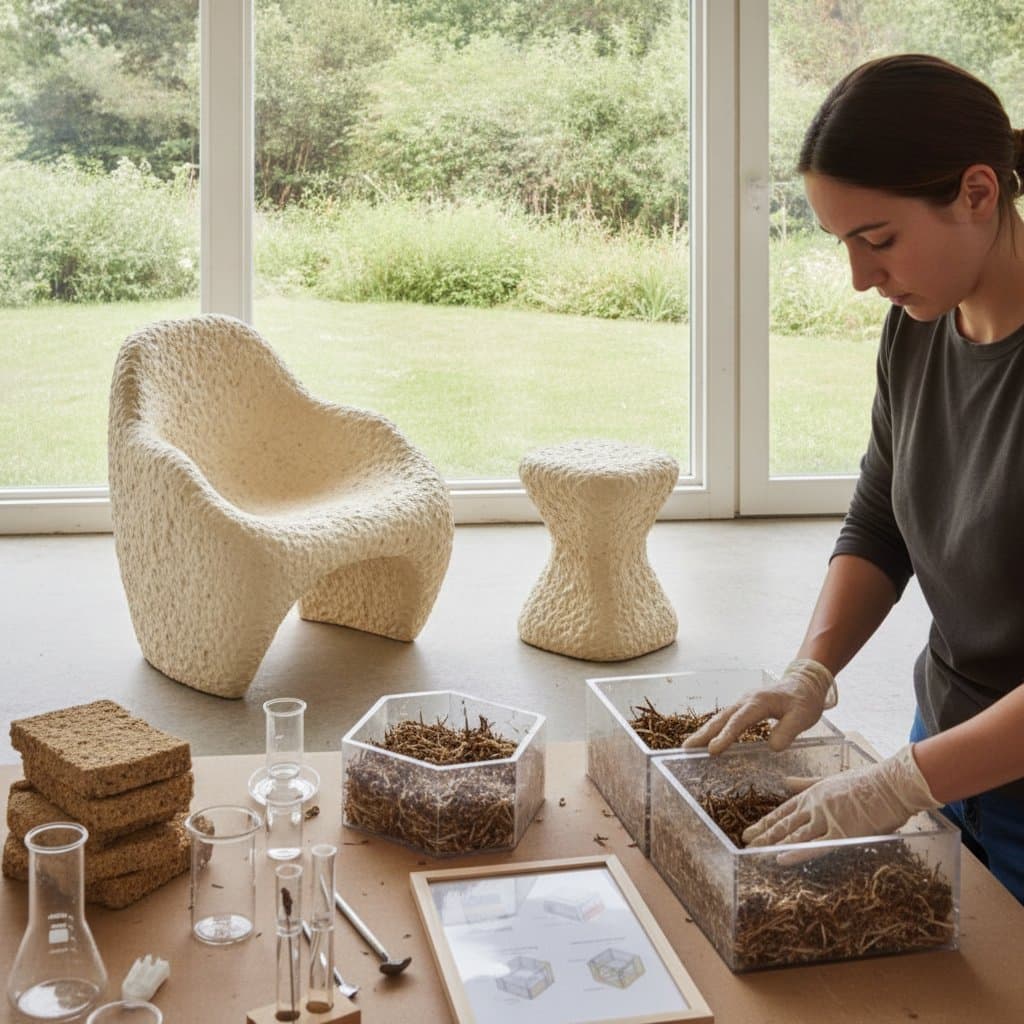
Using mycelium as a structural binder changes production methods. Makers mix agricultural waste such as sawdust, hemp hurd, or straw with mycelium spores. The blend is packed into a mold and left to grow for several days until it binds into a dense, foam like mass. Once baked to stop growth, the piece becomes rigid and ready for sanding or sealing.
Workshop trials produce molded stools with soft organic curves, lamp shades with translucent glow, and wall tiles that resemble suede. Each piece carries the texture of the mold surface and the subtle pattern of natural growth. One designer who used mycelium to form modular shelves with wood joinery noted that the material feels alive even when finished. It is light but surprisingly strong.
Practical Specifications
Material composition typically combines mycelium with shredded wood fiber or agricultural residue in ratios of 60 percent substrate to 40 percent mycelial mass. Mold construction uses simple plywood boxes, silicone trays, or 3D printed forms ranging from 12 to 24 inches wide. Growth occurs at room temperature for three to five days, followed by heat curing at 200 degrees Fahrenheit to deactivate spores. Surface finishing involves sanding followed by natural sealers such as beeswax or shellac for water resistance.
The material offers insulating quality and a neutral color palette that blends easily with wood frames or metal legs. Designers experiment with hybrid builds that combine mycelium shells with maple or ash supports for strength and contrast. Lightweight panels reduce shipping weight by up to 70 percent compared to medium density fiberboard.
Workshop Implementation Steps
- Source clean agricultural waste and a compatible mycelium spawn from a bio fabrication supplier.
- Prepare reusable molds with release agents to ensure clean demolding after growth.
- Pack the substrate and spawn mixture firmly, then incubate in a controlled environment free of contaminants.
- Monitor growth daily and apply heat curing once the form holds its shape.
- Sand and seal the cured piece, then integrate it with traditional wood joinery where additional strength is required.
This approach supports compound curves and hollow forms that would be difficult with solid wood. It reduces tool demands and offcut waste in compact workshops.
Performance and Lifecycle Benefits
Mycelium composites achieve compressive strength similar to lightweight particleboard at a fraction of the weight. That makes them suitable for stools, acoustic panels, or decorative fixtures. The substrate often consists of agricultural waste, so each piece diverts material from landfills. Once discarded, mycelium furniture can compost naturally.
The process remains safe for home use and requires only molds, a growth mix, and an oven for curing. Kits are available from suppliers, or makers can source local farm byproducts to experiment.
Daily Use and Care
Mycelium furniture performs best indoors away from direct moisture. It can be repaired with a paste of rehydrated fiber and fungal spores if chipped. Over time the patina deepens into a soft matte tone that pairs well with unfinished oak or linen.
This method changes how makers consider furniture life cycles. Instead of extracting and discarding, the sequence becomes cultivate, use, and return. The technique complements wood rather than replaces it. For the DIY maker, mycelium offers both experiment and evolution in growing design from the ground up.