
Why Japandi Joinery Defines 2025 Minimalist DIY
Japandi joinery combines the patience of Japanese craftsmanship with the restraint of Scandinavian design. The result produces furniture that appears light yet remains grounded, minimal yet tactile. For DIY woodworkers, this hybrid method represents modern making: honest materials, clear structure, and beauty derived from precision.
As the minimalist DIY movement expands, makers seek techniques that yield calm, durable pieces without excess hardware. Japandi joinery meets this demand. It refines traditional methods into soft geometry and functional clarity, where the structure serves as ornament.
At a Glance
Who: Home woodworkers and small shop makers
Where: Global online and local workshops
Size: Works range from 24-inch (61 cm) stools to 84-inch (213 cm) tables
Design Reference: Japandi blend of Japanese and Scandinavian traditions
Photography: Studio light, neutral backdrops, soft side illumination on wood grain
The Core Challenge and Defining Move
Modern DIY makers confront two pressures: speed and soul. Prefabricated hardware accelerates assembly but diminishes character. Hand-cut joints demand skill yet reward patience with visual harmony. The defining element of Japandi joinery lies in restraint. Every line, joint, and finish contributes to balance.
Furniture designer Lin Taro observed, “When you see a joint that fits without glue or metal, you feel calm. The piece tells you it will last.” That quiet confidence captures the style's essence.
Before: The Clutter of Modern Making
Many workshops prioritize convenience. Screws, brackets, and fasteners enable quick assembly. However, the outcome often appears temporary. Corners gap, finishes chip, and styles fade. Typical home office or dining sets exhibit this wear. Surfaces use laminate, edges remain sharp, and pieces lack proportion.
DIYer Nora Jensen described her frustration before adopting new methods. “I was building fast but not proud. The furniture worked but did not feel connected,” she said. Her experience reflects a broader shift: less clutter, more connection.
After: The Japandi Transformation
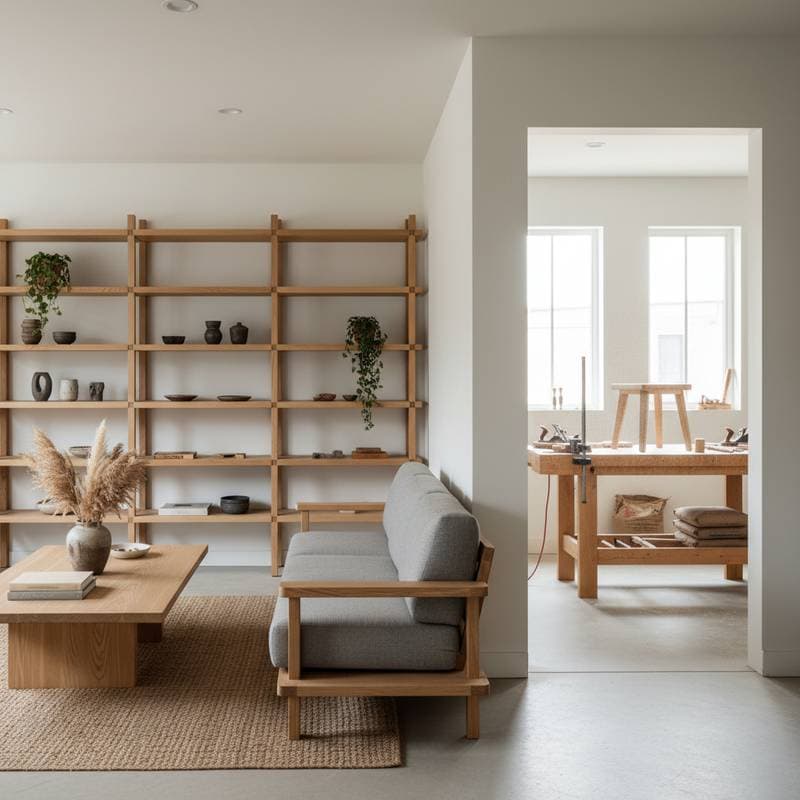
In a Japandi-inspired shop, the workbench conveys calm. Boards stack by tone, not just size. Joinery defines the style. A tapered leg fits into a mortise with minimal clearance. The seat edge shows a subtle shadow line from hand carving. Light interacts with the grain rather than reflecting off lacquer.
Projects start with proportion. A table at 29 inches (74 cm) high with a 1-inch (2.5 cm) top provides visual lift. Drawer faces align in rhythm, often with finger joints that reveal the joinery as pattern. The outcome feels intentional and timeless.
Designer Akiko Yamura noted, “We follow the grain, not fight it. The joint is not decoration, it is structure.” Photographs depict pieces that seem to float on tapered legs while supporting weight with quiet strength.
Design Details
- Materials: Ash, oak, or maple with matte oil finish. Bamboo for accents.
- Joinery Types: Half-lap, mortise and tenon, dovetail, and kumiko lattice inserts.
- Hardware: Minimal. Hidden brass pins or wooden dowels.
- Lighting: Warm white at 2700K, diffused through paper or linen shades.
- Storage Tricks: Sliding panels instead of hinged doors, shallow drawers for tools, open cubbies that keep essentials visible yet tidy.
- Finishes: Hand-rubbed oil, natural wax, or soap finish for a dry, tactile surface.
Each selection promotes clarity. The structure reveals itself at a glance, fostering trust between maker and material.
Layout and Flow in the Workshop
Japandi joinery shapes workspace arrangement. Rather than crowded tool walls, the setup creates zones of calm. A central bench at 36 inches (91 cm) high anchors the room. Hand tools hang in simple order, chisels to the left, planes to the right. Natural light falls across the bench from one side, highlighting grain direction during work.
A nearby shelf holds offcuts sorted by length, promoting reuse. Clutter diminishes, not conceals. Movements from cut to assembly proceed deliberately. This flow echoes the furniture: efficient, quiet, and grounded.
Key Techniques and Why They Work
1. Mortise and Tenon Precision
This classic joint holds central importance. Hand cutting with a marking gauge and sharp chisel builds patience. The fit requires light tapping, never force. The visible shoulder creates a clean line that embodies Japandi symmetry.
2. Kumiko Panels
Drawn from Japanese screens, kumiko panels add pattern through shadow, not color. In a Scandinavian setting, these lattices substitute geometry for ornament. Light play introduces softness to linear forms.
3. Exposed Joinery as Design
Visible dovetails or dowel heads declare honesty. Sanded flush and oiled, the contrast between end grain and side grain forms a subtle graphic. This approach elevates the joint beyond utility.
4. Floating Tops and Shadow Gaps
A 1/8-inch (3 mm) reveal between surfaces imparts lightness. These gaps draw from architectural joints in Japanese and Nordic interiors, enhancing perceived float.
5. Natural Finishes
Penetrating oils highlight fiber structure over gloss or polyurethane. The surface remains alive, not sealed. Renewal occurs easily with another coat, prolonging piece life.
Practical Bridge: Applying Japandi Joinery at Home
A full studio proves unnecessary to begin. Key adjustments guide work toward this direction.
- Simplify the palette. Select one or two wood species and maintain consistency. Contrast arises from grain, not color.
- Invest in sharp tools. A fine chisel and reliable plane produce superior joints over clamps alone.
- Sketch proportions. Balance benefits even a small shelf. Apply a two-to-three ratio for width to height.
- Work with natural light. Place the bench where daylight reveals grain. Shade lamps to minimize glare.
- Finish mindfully. Rub oil with a lint-free cloth, allow breathing, then buff lightly.
These steps introduce measured slowness to reveal detail. The process integrates into the reward.
Why It Matters Now
Minimalism evolves beyond sterile spaces. People seek warmth and purpose. Japandi joinery infuses minimalism with human touch. Surfaces narrate their creation. Precision in joints supplants ornament, wood texture replaces gloss.
Interior stylist Mikkel Sorensen stated, “People crave calm spaces, not empty ones. Japandi joinery builds calm through care.” The approach suits modern life with limited space and divided attention. Durable joinery endures decades, curbing waste and distraction.
Comparing Styles: What Sets Japandi Apart
| Feature | Traditional Japanese | Scandinavian | Japandi Blend |
|---|---|---|---|
| Proportion | Low, grounded | Light, elevated | Balanced lift |
| Joinery | Complex hand-cut | Simple dowel | Simplified mortise and tenon |
| Finish | Natural oil or lacquer | Soap or white oil | Soft matte oil |
| Color Tone | Warm wood | Cool neutral | Neutral with warm accents |
| Form | Organic curves | Straight lines | Curved edges with straight planes |
This comparison illustrates how Japandi merges strengths, blending calm geometry with tactile warmth.
Key Takeaways
- Less Hardware, More Skill: Piece integrity depends on fit, not fixtures.
- Light as Material: Illumination on joinery lines integrates into design.
- Sustainability through Longevity: Sturdy joints shorten replacement cycles.
- Tactile Surfaces: Hand-rubbed finishes promote care and repair.
- Emotional Connection: Slow making yields pieces worth preserving.
Joints and edges convey attention. The outcome extends to a lifestyle of mindful creation.
Living with Your Design
Japandi joinery in the home offers benefits past aesthetics. Cleaning simplifies as flush surfaces gather less dust. Natural finishes age with grace, gaining soft sheen through use. Light shifts across wood daily, altering mood effortlessly.
Homeowner Elise Tanaka shared, “When the morning sun hits the table, you see the joint shadow. It reminds me someone cared enough to cut it right.” Such awareness transforms routines into rituals.
Building on Your Skills
For DIY makers, Japandi joinery offers lifelong study. Begin with a stool or small bench, progress to cabinets or tables. Each project hones sensitivity to proportion, fit, and finish. Record cuts, note tolerances, and photograph joints pre-assembly. Accuracy improves over time.
Workshops and online lessons emphasize this craft. They convey technique alongside mindset: patience, clarity, and wood respect. Homes fill with calm furniture, born from calm building.