
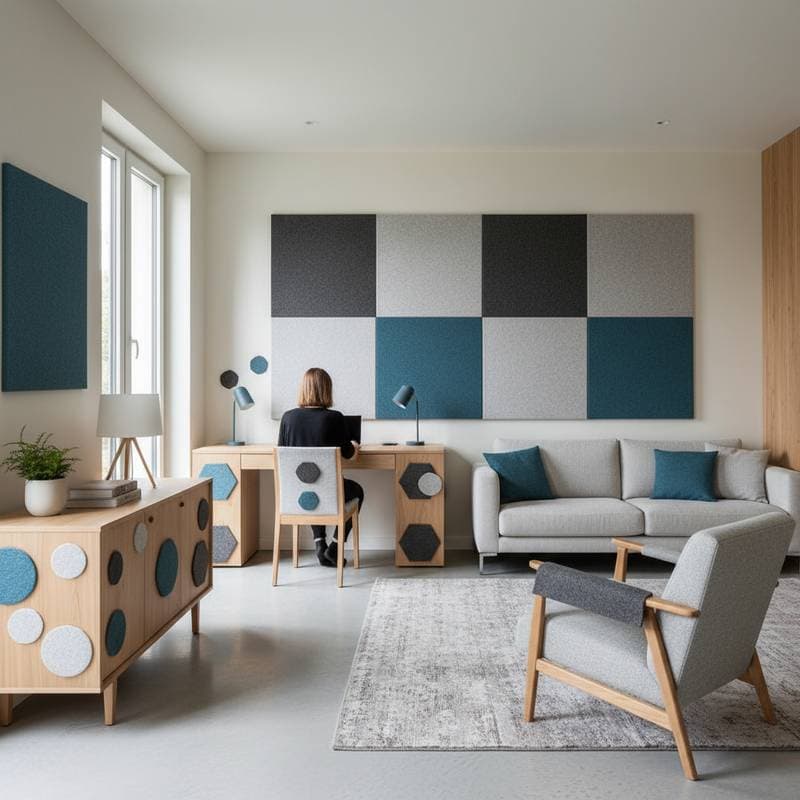
DIY Acoustic Felt Panels: Silence Furniture and Enhance Spaces
Quiet design gains prominence as residences serve dual purposes as offices and open floor plans intensify ambient noise. Acoustic felt emerges as a favored solution among makers. This versatile material mitigates echoes, introduces tactile depth, and forms panels suitable for furniture integration or wall applications. The process requires only fundamental tools, adhesive, and strategic placement to target primary sound reflection points.
This guide delineates the principles of acoustic felt, outlines panel design strategies for seamless integration, and provides instructions for incorporation into furniture or cabinetry to yield serene, refined environments.
At a Glance
Primary users: Woodworkers crafting home projects, furniture constructors, and interior designers seeking acoustic management.
Ideal applications: Recording studios, family living areas, compact office corners, and communal living spaces.
Essential materials: Acoustic felt sheets, medium-density fiberboard (MDF) or plywood backing, spray adhesive, utility knife, metal straightedge, and optional wood framing strips.
Required skills: Intermediate level, encompassing precise measurements, clean cuts, and organized layouts.
Core design principles: Geometric precision, concealed mounting hardware, and harmonious color integration.
Principles of Acoustic Felt Efficacy
Acoustic felt consists of densely compressed synthetic or natural fibers engineered to capture and disperse sound waves. Its structure excels at attenuating mid-range and high-frequency sounds, which contribute significantly to reverberation and piercing noises. When affixed to rigid substrates such as wood panels or gypsum board, it suppresses sound reflections and fosters a more controlled auditory environment.
Professionals characterize the outcome as muting the harshness within a space. Audio becomes intimate and localized, prioritizing the source over surrounding acoustics.
Beyond functionality, felt panels impart visual interest through varied textures. Subtle weaves in neutral shades integrate discreetly with cabinetry, whereas vibrant colors delineate functional zones in expansive layouts.
Challenges Posed by Reflective Surfaces
Woodshops and domestic areas commonly suffer from acoustic deficiencies due to unyielding materials. Solid wood flooring, finished walls, and windows propagate footsteps, conversations, and other sounds. In confined spaces, these echoes compound into a phenomenon known as flutter echo, where rapid reflections create disorienting auditory clutter.
A recent home office renovation featured felt lining behind an oak desk. The occupant noted, “I loved the look of my oak desk, but every call sounded hollow. Once I added felt to the wall behind it, the difference was immediate.”
The key lies in harmonizing aesthetics with acoustics. Panels must align with furniture contours without evoking professional studio aesthetics.
Outcomes: Integrated Panels for Acoustic and Visual Harmony
Panels tailored to echo furniture profiles recede visually while transforming spatial acoustics. The resulting soundscape softens, positioning furniture as an active component in noise mitigation.
Identify high-impact zones first, such as room corners, elevated ceilings, and surfaces adjacent to desks or storage units. Strategic placement intercepts sound prior to reflection. Applying slim felt layers to furniture rear panels or cabinet interiors curbs vibrations, particularly in resonant hollow constructions.
A specialist in adaptable interiors explains, “We treat sound like light. You can direct it, diffuse it, and layer it. Felt gives you control without changing your architecture.”
Step-by-Step Implementation
1. Develop a Layout Plan
Draft a schematic of the target wall or furniture element. Indicate prominent reflection zones based on sound mapping. Apply painter's tape to prototype arrangements, then clap hands to evaluate echo diminution. Distribute panels uniformly for optimal balance and efficacy over monolithic coverings.
2. Select Appropriate Felt
Opt for acoustic felt measuring at least 3/8 inch (10 millimeters) in thickness to ensure robust absorption. Denser variants perform superiorly. Standard sheets measure 4 by 8 feet (1.2 by 2.4 meters); procure excess for adjustments. Recycled polyethylene terephthalate (PET) felt offers longevity and clean cutting properties.
Consider hue for cohesion. Light gray or taupe complements wood grains effectively. Deeper tones like navy or forest green ground professional settings.
3. Prepare and Assemble Panels
Employ 1/4-inch (6-millimeter) MDF or plywood as substrate, sized to match the felt. Apply spray adhesive in uniform layers, align the felt from one edge, and eliminate bubbles with a roller. Excise excess using a fresh utility knife guided by a straightedge.
For framed assemblies, incorporate a 1/8-inch (3-millimeter) border to accommodate trim.
4. Install Panels Firmly
Wall-mounted panels benefit from keyhole brackets or French cleat systems. Position units 3/4 inch (19 millimeters) from the surface to enhance airflow and absorption. On furniture, secure with construction adhesive or countersunk screws paired with washers, concealed by edging. Verify measurements prior to any penetration.
5. Incorporate Lighting Layers
Acoustic enhancements pair well with multifaceted illumination. Direct spotlights toward panels to accentuate texture and dimension. Employ wall-washing fixtures or concealed LED tapes behind suspended panels for subtle radiance without harsh shadows.
Essential Design Specifications
- Panel composition: 3/8-inch (10-millimeter) felt layered over 1/4-inch (6-millimeter) MDF.
- Installation offset: 3/4-inch (19-millimeter) separation from walls to optimize sound capture.
- Standard dimensions: 24 by 24 inches (61 by 61 centimeters) for grid patterns, or 48 by 12 inches (122 by 30 centimeters) for linear accents.
- Finishing touches: Oiled oak or walnut borders for organic appeal.
- Recommended colors: Versatile options include gray, sand, charcoal, and navy.
Adapt these parameters readily for furniture facades or internal cabinetry.
Core Insights
1. Targeted coverage yields substantial results. A modest area of felt significantly reduces reverberation. Prioritize initial reflection sites near workstations, media displays, or sleeping areas.
2. Embed within furniture structures. Line shelving interiors, cabinet doors, or table undersides. Such placements dampen resonances and stabilize loose components.
3. Pair with complementary elements. Incorporate area rugs, drapery, and cushioned furnishings to amplify absorption. Maintain tonal unity for cohesive serenity.
4. Evaluate progressively. Post-installation, assess auditory shifts by traversing the space and monitoring footfalls or dialogue. Refine intervals as needed.
5. Preserve condition simply. Clean with a soft-bristle vacuum attachment. Address spots using a damp cloth with diluted soap; refrain from saturation to protect bonds.
Advanced Techniques
- Vary geometries for diffusion. Triangular hexagons, squares, or elongated slats alter reflection patterns uniquely.
- Apply contrast judiciously. Dark felt against pale wood generates contrast and underscores artisanal quality.
- Standardize gaps. Uniform 1-inch (25-millimeter) separations between panels convey professionalism.
- Select durable fixtures. Opt for slim cleats or magnetic systems to facilitate maintenance and reconfiguration.
- Cost considerations: Materials range from 6 to 10 dollars per square foot (65 to 108 dollars per square meter), scaled by density.
Experiencing the Transformation
Installed panels extend influence beyond acoustics. Spaces acquire stability, dialogues remain intimate, and productivity rises. The material's inviting surface encourages interaction, tempering the austerity of wood-dominated designs.
One resident observed, “It’s like the room took a deep breath. The furniture feels part of the space, not just placed in it.”
For woodworkers engaged in construction or restoration, acoustic felt expands creative possibilities, merging utility with elegance.