
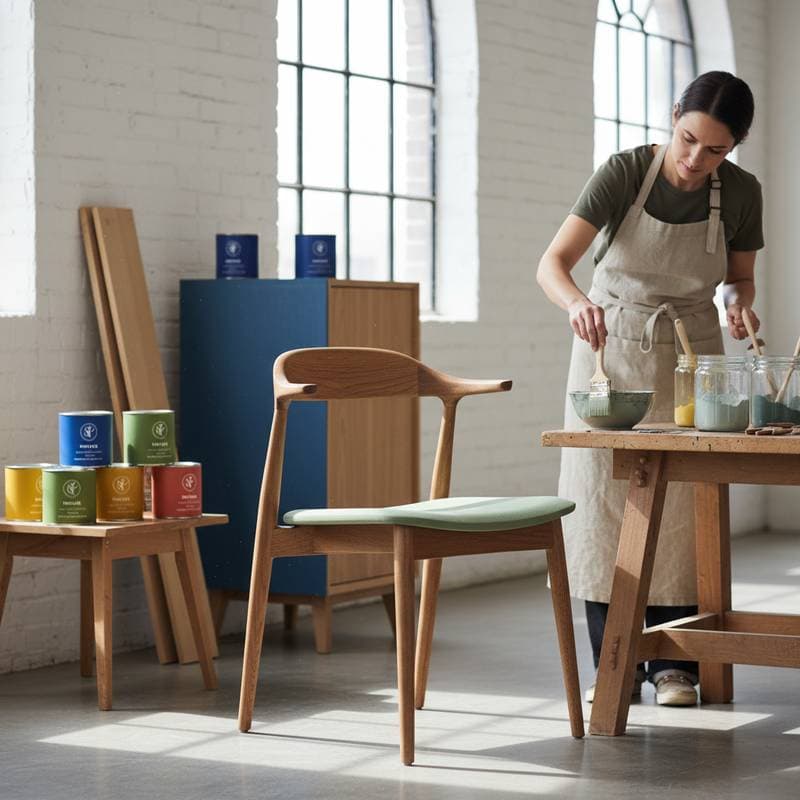
Why Milk Paint Emerges as the Premier Eco-Friendly Wood Finish for 2026
Milk paint returns to contemporary workshops and design studios with renewed purpose. Historically associated with rustic farmhouses, this finish now attracts woodworkers who prioritize non-toxic, natural options that reveal wood grain while maintaining clean indoor air. Its visual charm combines with environmental benefits: a subtle matte sheen, full biodegradability, and permeability that prevents moisture buildup or harmful emissions.
At a Glance
Primary users: Professional furniture fabricators, cabinetry specialists, and residential DIY practitioners emphasizing organic materials
Ideal applications: Bespoke furniture pieces, limited-run cabinet installations, and heritage restoration efforts
Composition: Protein-derived coating from milk casein, lime, and earth-based pigments
Key attributes: Free of toxins, resilient to wear, and simple to mend
Image credit: Studio Stillwood Interiors
Project collaborators: Green Grain Workshop
Transition to Natural Finishing Options
Awareness of finish ingredients has intensified among woodworkers and interior designers. Solvent-heavy coatings often emit volatile organic compounds that persist in enclosed spaces. As demand rises for low-emission alternatives, milk paint positions itself as a reliable, genuine choice.
Designer Liam Porter notes, “We sought a finish that allows the wood to convey its narrative. Milk paint penetrates variably across boards, ensuring each item appears authentic.” This inherent inconsistency, previously viewed as quaint, now receives acclaim for adding substantial texture and nuance.
Facilities that reserved milk paint for vintage revivals increasingly apply it to sleek contemporary designs. It integrates seamlessly with straight-grained hardwoods like oak or maple, yielding hues that evoke serenity and stability.
Advancements in Formulation and Their Impact
Recent milk paint developments streamline preparation, prolong usability, and ensure reliable adhesion compared to traditional recipes. Dry powder forms seal securely for storage and activate with water on demand, minimizing spoilage and maximizing longevity.
Producers have optimized pigment proportions, enabling precise intensity adjustments. The outcome delivers a heritage-inspired appearance with dependable modern performance. Thin applications accentuate porous grain structures; multiple layers form a robust barrier that polishes to a gentle luster.
For operations committed to sustainability, these improvements yield tangible gains. Absent synthetic adhesives, cleanup involves solely water. Tools rinse without chemical aids, and remnants decompose naturally, aligning with zero-waste methodologies.
Challenges of Traditional Finishes
Operations dependent on oil-based varnishes encountered significant ventilation demands. Dedicated finishing areas necessitated robust exhaust systems, yet residual vapors often compromised overall air purity.
Home applicator Ana Chen recalls, “I appreciated the transparency of oil varnish, but it required prolonged respirator use. I needed a professional-grade option that prioritized safety.”
Such finishes typically create impermeable barriers. These can encapsulate humidity, prompting irregular wood movement and potential surface failures like splits or delamination, particularly in moisture-prone areas such as kitchen surfaces or basin-adjacent cabinetry.
Benefits of Adopting Milk Paint
Adopting milk paint alters operational dynamics and environmental conditions positively. Rapid curing supports several applications within one session. It adheres directly to unprepared wood, yielding a smooth, tactile surface that preserves grain visibility.
Photographs from professional settings illustrate birch panels with nuanced shading under ambient illumination. The non-reflective quality softens light diffusion and emphasizes structural details. On a walnut seating piece, a light sage layer partially removed at edges reveals underlying tones, achieving an enduring yet deliberate patina.
Streamlined processes eliminate extended drying waits and aggressive cleaners. Basic brushes or foam tools suffice over complex sprayers, facilitating efficient small-scale output.
Application Essentials
- Core ingredients: Casein extracted from non-fat milk, slaked lime, and pigments such as iron oxide or ultramarine blue
- Tools for use: Bristle brushes from natural fibers, foam applicators, or spray equipment for expansive areas
- Preparation steps: Abrade surface to 180-grit smoothness, remove particles with vacuum, and apply a light water mist prior to coating
- Mixing proportions: Combine equal parts powder and water, refining to a smooth, creamy texture
- Curing duration: Approximately 30 minutes per layer under standard humidity levels
- Sealing choices: Retain matte for authentic vintage character or top with plant-based oil for subdued shine
- Post-application care: Rinse with warm water exclusively, bypassing chemical removers
- Preservation method: Store dry powder in sealed vessels for unlimited duration
Chemical Principles of Durability
Milk paint achieves strength via inherent reactions. Lime interacts with casein to form a mineral-infused layer that endures without flaking. Fully set, it withstands decades of exposure. Distinct from polymer-based paints, no artificial overlay develops; integration occurs at the cellular level.
This permeable design permits vapor exchange, stabilizing wood against internal pressures. Surfaces remain intact amid humidity fluctuations, aging harmoniously without fractures. Such adaptability proves essential for items in variable environments, from outdoor enclosures to active studios.
Techniques for Layering and Hue Management
Contemporary suppliers provide over twenty foundational colors, all sourced from mineral origins. Custom shades emerge by intermixing powders pre-hydration. Adding a small amount of dark pigment intensifies greens; subtle earth tones like raw sienna enhance lighter bases.
Professionals build complexity through successive applications. An initial deep tone under a pale overlay, selectively abraded at high-wear zones, simulates natural aging. This method excels on traditional forms like paneled cabinetry or sculpted supports.
Porter adds, “We incorporate subtle signs of use on fresh creations. It instills immediate vitality in the piece.”
Operational Efficiencies in Professional Settings
Milk paint accommodates diverse scales, from artisanal benches to scaled manufacturing.
- Safety protocols: Eliminates need for protective masks or handling gear
- Production pace: Accelerated drying shortens project timelines
- Restoration ease: Minor damages repair seamlessly with localized applications
- Material versatility: Adheres to fresh lumber, composite boards, and prepared prior coatings
- Ecological profile: Decomposes completely, derived from replenishable sources
These features bolster branding for environmentally aware enterprises. Clients value finishes suitable for direct contact or home experimentation.
Pricing and Availability Considerations
Powdered milk paint typically costs 20 to 30 dollars per quart equivalent, covering about 70 square feet or 6.5 square meters. Though pricier than mass-produced synthetics, reduced discard balances expenses. Surplus dry material retains potency indefinitely.
Powder format lowers shipping mass, curbing transport emissions. Compact storage suits modest inventories in boutique operations.
Essential Insights
- Milk paint provides a toxin-free substitute for chemical-laden alternatives
- It amplifies natural patterns rather than concealing them, enriching tactile and visual interest
- Updated recipes enhance preparation simplicity, longevity, and shade precision
- Sustainable practices benefit from non-hazardous disposal and organic composition
- Permeable qualities promote stable aging and diminish failure risks
Everyday Performance and Care
Protected by natural oils or waxes, milk paint demonstrates robust longevity. Work surfaces repel liquids effectively, while storage units maintain cleanliness with gentle soap solutions. Gradual edge polishing develops a soft glow, enhancing overall appeal.
For uniform renewal, apply fresh coats over existing layers without full stripping. Chemical affinity ensures adhesion, revitalizing appearance economically.
Integrating Milk Paint into Broader Designs
Creatives combine milk paint with elements like woven fibers, textiles, and metallic accents. Its understated surface offsets glossy companions, fostering equilibrium. In up-to-date spaces, subdued tones in blue or terracotta promote tranquility.
Innovators test combinations, such as overlaying with diluted tung oil for faint gloss. Unprotected versions offer a powdery, engaging texture ideal for visual documentation.
Strategies for Long-Term Preservation
Regular dusting with soft cloths prevents buildup. For deeper cleans, use diluted natural soaps, avoiding abrasives that dull the finish. In high-traffic zones, periodic oil reapplications restore protective barriers and deepen color saturation.
Monitor humidity levels to avert excessive expansion; maintain 40 to 60 percent relative humidity for optimal stability. Address scratches promptly with matching pigment mixes, feathering edges for invisible repairs.