
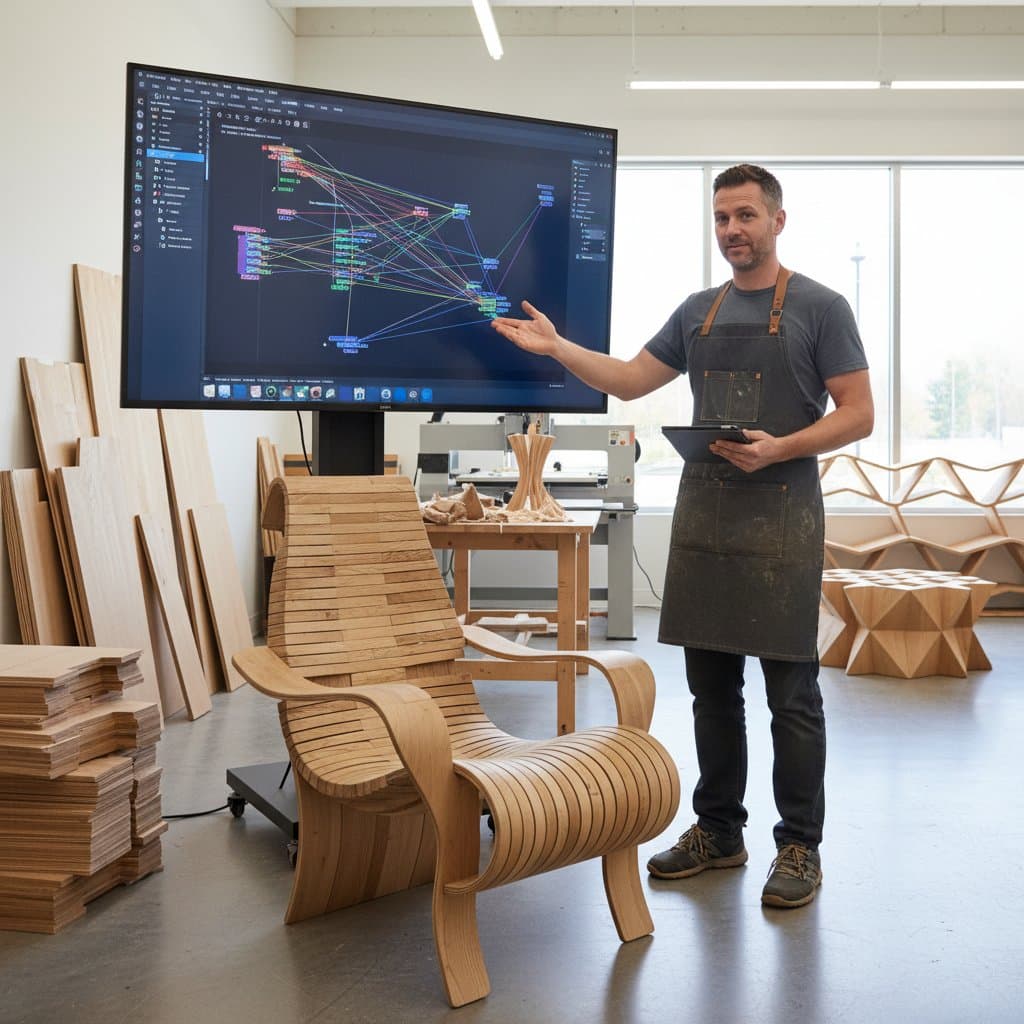
Parametric Design Revolutionizes Custom Furniture
A single algorithm shapes an entire table, chair, or cabinet before a saw touches wood. Parametric design changes how custom furniture is imagined, modeled, and built. Tools such as Grasshopper for Rhino or other parametric software turn design logic into a living system that responds instantly to size, material, and client needs.
At a Glance
- Average cost for parametric furniture prototypes: $350 to $1,200
- Software used: Grasshopper, Rhino, Fusion 360, FreeCAD
- Skill level: Intermediate to advanced
- Production time savings: 25 to 50 percent over manual drafting
How Parametric Design Works
Parametric design replaces static drawings with dynamic rules. Designers define relationships between dimensions, joints, and materials. When one variable changes, the entire model updates automatically. For example, increasing the height of a table adjusts leg angles and support spacing without redrawing.
Grasshopper, a visual programming plugin for Rhino, serves as the most common tool among furniture designers. It employs nodes and wires to represent parameters such as width, curvature, or cut thickness. Once established, designers test dozens of versions in minutes rather than hours.
This process proves especially powerful in woodworking. Simulations account for kerf bending, grain direction, and sheet optimization before cutting begins. The outcome includes fewer material errors, faster iteration, and more consistent joinery.
Action step: Begin with a small project like a stool or shelving unit. Define three or four parameters, such as height, board thickness, and slot width. Adjust them in Grasshopper to observe how the form evolves.
Why It Matters for Custom Furniture
Traditional furniture design relies on static drawings. Every variation demands redrawing. Parametric design eliminates that repetition. If a client requests a table 10 inches longer, the algorithm recalculates all parts instantly.
This flexibility supports mass customization and one-off pieces alike. Small workshops respond to individual requests without extending design time. Large manufacturers automate batch variations while maintaining quality consistency.
Parametric design merges aesthetic freedom with structural precision. Curves follow mathematical functions to create organic shapes that meet engineering limits. A chair seat, for instance, generates from a sine curve that optimizes comfort and reduces material waste.
Action step: Build a parameter map before modeling. List every variable that affects the design, from material thickness to fastener type. Use it as a checklist for both digital modeling and physical fabrication.
Costs and Budget
The primary investment in parametric design involves software and learning time. Rhino requires a license fee of approximately $995, with Grasshopper included. Free alternatives like FreeCAD or Fusion 360 parametric tools suit beginners. Professionals may allocate $1,500 to $2,500 for software, plugins, and training materials.
Material costs vary with design complexity. Parametric furniture often utilizes sheet goods like plywood or MDF for CNC cutting. A 4x8 foot sheet ranges from $65 for standard plywood to $150 for high-grade veneer. A small parametric table typically requires two to three sheets.
Efficiency delivers the payoff. Once design logic is established, updating each new piece takes only 10 to 15 minutes. Workshops report 30 to 40 percent savings in design labor per project. For a shop billing $80 per hour, this equates to $240 in potential savings per project.
Money-saving tip: Share scripts and parametric templates among the team. A modular library of joints, panels, and connectors reduces repetitive setup time.
DIY or Professional
DIY makers explore parametric design with patience and a commitment to learning coding logic. Essential tools include a capable laptop, Rhino with Grasshopper, and access to a CNC router or laser cutter. Most small projects, such as stools or wall shelves, complete in 10 to 15 hours after mastering the workflow.
Professional shops benefit most from automation and precision. Parametric modeling coordinates design, fabrication, and assembly data. For example, export cut paths directly to CNC software or generate bill-of-materials spreadsheets automatically.
When DIY makes sense:
- Existing CAD use with a desire for added flexibility.
- Projects under 4 feet in dimension.
- Access to a makerspace CNC machine for under $50 per hour.
When to hire or upgrade:
- Projects exceed 6 feet or require heavy joinery.
- Need for parametric nesting in large sheet optimization.
- Clients expect repeatable designs or digital fabrication files.
Action step: Test the workflow with a digital prototype. Export a scaled-down version in cardboard or MDF before full-size production.
Common Mistakes to Avoid
Parametric modeling presents new challenges. Logic breaks if relationships lack proper definition. The following addresses frequent issues and solutions.
- Overcomplicating scripts. Beginners add excessive variables. Start simple.
- Ignoring material behavior. Wood expands and contracts. Include tolerance parameters for joint fit, typically 0.2 to 0.4 millimeters for CNC cutting.
- Skipping documentation. Label parameters and maintain notes. Future edits demand clarity.
- Neglecting fabrication feedback. Simulate the entire toolpath before cutting. Verify tabs, slots, and kerfs align with machine settings.
- No version control. Save iterations with descriptive names. Small changes yield significant structural differences.
Action step: Create a test cut file to check joint fit and curve smoothness on scrap material. Adjust parameters until the fit proves consistent and repeatable.
Living with Your Design
Parametric furniture excels in adaptability. Reconfigure a piece years later by altering a few variables and rerunning the model. Generate replacement parts on demand. This approach fosters sustainability and future-proofing.
The design logic serves as a reusable asset. Apply a strong parametric template to new materials or dimensions without restarting. A chair template transforms into a bench or bar stool by adjusting sliders.
Key benefits that last:
- Repeatability: One file produces multiple product lines.
- Repairability: Parts maintain consistency across replacements.
- Customization: Clients define dimensions or patterns within safe limits.
For woodworking businesses, this establishes a new service category. Sell design systems alongside pieces. Clients receive furniture and the digital framework for future customization.
Action step: Archive Grasshopper definitions and export clean DXF or SVG files for every project. Label them by version and material type. This builds a digital inventory that increases in value over time.
Resources and Visual Aids
Parametric design transcends trends. It provides a practical method to blend creativity and precision in custom furniture. Witnessing a design adapt quickly alters perspectives on every joint, curve, and cut.