
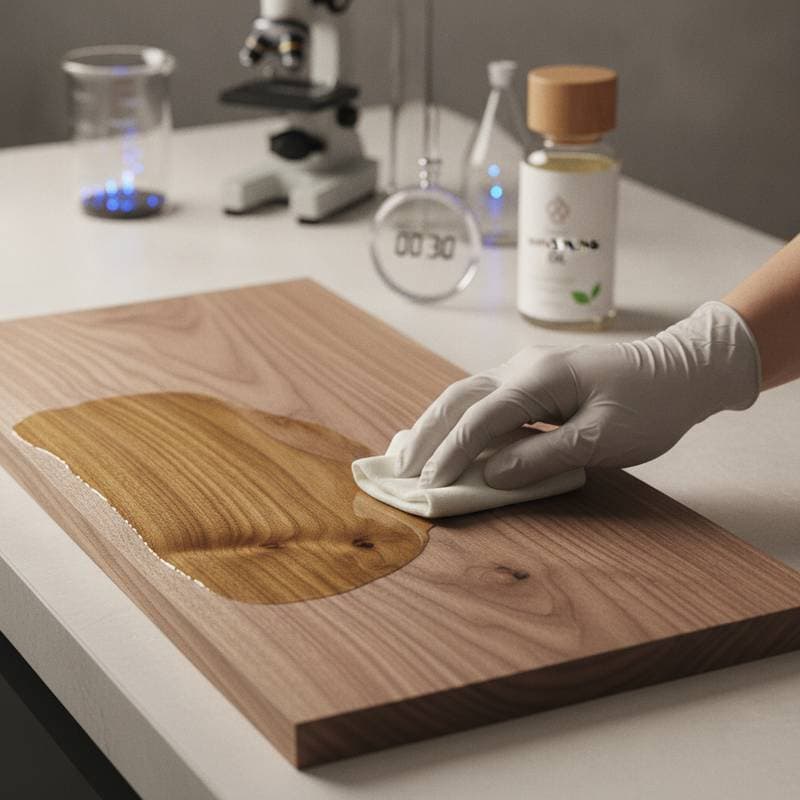
Nano Tung Oil Upgrade Revolutionizing Natural Finishes
Woodworkers and finishers have long trusted tung oil for its warm tone and natural protection. The latest generation, nano tung oil, takes that tradition further by combining classic plant-based chemistry with modern particle technology. The result is a finish that penetrates deeper, cures faster, and protects longer, while keeping the tactile feel that defines real wood.
At a Glance
Product Type: Nano-enhanced tung oil finish
Applications: Furniture, cabinetry, flooring, and turned objects
Finish Style: Natural matte to low satin
Key Innovation: Nano-particle dispersion for deeper penetration and faster cure
Photography: Studio detail shots by Erik Lund, process imagery by Clay Harper
Before
Traditional tung oil finishes draw praise for their natural luster but can frustrate users. The slow drying time, inconsistent sheen, and limited water resistance often demand multiple coats and long wait periods. Makers who rely on tight production schedules find that the curing delay disrupts workflow.
“I loved the glow of pure tung oil, but waiting several days between coats slowed projects to a crawl,” said furniture maker Dana Ruiz. “It limited how much I could deliver in a week.”
These challenges pushed chemists and finish developers to reimagine how tung oil behaves once it meets the wood grain.
After
Nano tung oil changes that story. By dispersing tung molecules within a nano-scale carrier, the finish moves through the wood’s capillaries more efficiently. The oil bonds at a cellular level, creating a denser, more uniform barrier. The surface still looks hand-rubbed, but the protection rivals that of synthetic sealers.
In testing, users reported that a single coat penetrated up to 40 percent deeper than standard tung oil. Cure time dropped from several days to a few hours under normal shop conditions. The product can be burnished or buffed the same day, a major shift for both custom and production work.
Lighting tests show why the difference matters. Under raking light, wood finished with nano tung oil maintains even reflection across wide panels. There are no dull patches or sticky spots, and open-grain woods like oak and ash show smooth transitions between early and late growth rings.
“The nano dispersion means the oil carries itself into every pore,” said finish chemist Rachel Kim of ArborTech Labs. “You get depth and clarity without polymer build-up. It still feels like wood, not plastic.”
Design Details
Composition and Application
- Plant-derived tung base blended with nano-particle emulsifiers
- Solvent-free formula suitable for brush, cloth, or spray application
- Recommended coverage: 400 square feet per gallon (37 square meters per 3.8 liters)
- Dry-to-touch time: roughly 2 hours under standard shop humidity
Performance and Durability
- Enhanced water resistance due to tighter molecular crosslinking
- UV-stabilized variant available for outdoor furniture and boat interiors
- Maintains flexibility, reducing cracking on large panels and end grain
Appearance and Maintenance
- Natural matte finish with optional low-satin additive
- Easy to refresh with a light scuff and recoat
- Compatible with most wax or oil top layers for customized sheen
Safety and Storage
- Low-VOC, no residual odor after cure
- Shelf life of up to two years in sealed container
- Clean tools with mild soap and warm water
Key Takeaways
Nano tung oil represents a quiet revolution in natural finishing. It keeps the renewable foundation that makers value but introduces measurable efficiency gains. For small studios, faster cure times mean better throughput. For large shops, the deeper penetration translates to reduced rework and fewer callbacks.
The finish also aligns with growing demand for low-toxicity materials. Builders who supply wellness-oriented clients appreciate that the oil contains no heavy metals or harsh solvents. Flooring installers report fewer customer complaints about lingering odor or tackiness.
From a design standpoint, the finish enhances the visual rhythm of grain. On walnut, it deepens chocolate tones without a plastic gloss. On maple, it keeps the pale cream hue while adding subtle warmth. When applied to reclaimed timbers or live-edge slabs, it accentuates the history embedded in each board.
Nano tung oil also encourages more creative workflows. Because it levels quickly and does not require heavy sanding between coats, artisans can combine it with dyes, stains, or inlays. Turners find that it resists heat buildup on the lathe, and carvers appreciate how it seals delicate details without pooling.
For hobbyists, the simplicity is appealing. Wipe on, wait a short time, and buff lightly. The finish cures through oxidation and nano dispersion, not evaporation, so waste is minimal. Even small offcuts or sample boards can be treated for practice without losing material to thick film buildup.
Maintaining Your Investment
Once applied, maintenance is straightforward. Clean surfaces with a soft cloth and mild soap. For high-contact areas like tabletops, a light refresh coat every few years keeps the surface resilient. Because the finish bonds deep within the fibers, scratches often polish out with gentle rubbing rather than full sanding.
Shops using nano tung oil report lower material waste and reduced finishing room congestion. The faster turnover frees space for new projects and lowers energy costs tied to drying environments. These operational gains, while subtle, can shift the economics of small-scale woodworking.
For anyone seeking a natural finish that respects both tradition and time, nano tung oil delivers. It keeps the soul of hand-rubbed craftsmanship while embracing contemporary science.
Sources or Credits
Product Development: ArborTech Labs
Design Consultation: Dana Ruiz Studio
Photography: Erik Lund and Clay Harper
Technical Review: Rachel Kim, Finish Chemist.