
Tambour Doors: 2025's Slatted Cabinet Game-Changer
Tambour doors return in a contemporary form for cabinetry applications. Previously confined to roll-top desks, these flexible slatted panels now feature in kitchens, bathrooms, and workshops. Their appeal stems from fluid movement and inherent texture. The door glides along a track rather than swinging outward, which conserves space and introduces subtle rhythm to otherwise plain surfaces. For builders and designers, the tambour door emerges as a refined highlight in current millwork practices.
At a Glance
Who lives here: A family of four who cooks and entertains daily
Location: Portland, Oregon
Size: 320 square feet (29.7 square meters)
Design team: Lark & Grain Design Studio
Photographer: Clara Weston
Before
The kitchen appeared cramped and outdated. Hinged cabinet doors obstructed pathways, and upper storage proved difficult to access. The homeowners sought sleeker lines and improved circulation around the island. “We kept bumping into open cabinet doors,” said homeowner Daniel Lee. “It slowed everything down.”
The layout lacked visual rhythm. Uniform flat fronts on cabinets contributed to a heavy atmosphere. Natural light from the single window reflected unevenly off glossy surfaces, accentuating disorder rather than form. The design team recognized untapped potential but required a versatile door mechanism that operated without demanding swing space.
After
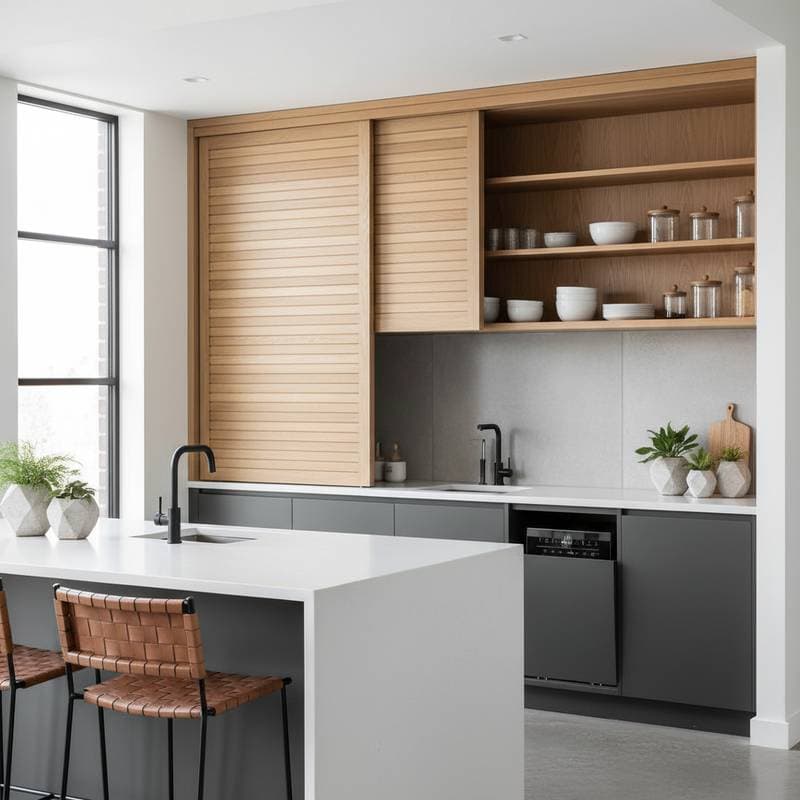
The renovation incorporated vertical tambour doors crafted from white oak, which extend around corners and appliances. Each slat measures approximately one inch (2.5 centimeters) in width, connected by a concealed fabric backing that enables the panel to roll effortlessly into its side track. In the closed position, the panels present as seamless wood surfaces. In the open position, they retract fully into a pocket above the countertop.
This approach delivers motion without disrupting the visual harmony. “The tambour door gave us motion and storage in one gesture,” said designer Erin Lark. The oak grain diffuses light gently, while the slats provide texture without added volume. The design team complemented the tambour fronts with matte quartz countertops and linear LED fixtures to highlight shadows and depth.
In the area where a swinging cabinet previously impeded the coffee station, a tambour door now rolls upward to expose a streamlined breakfast nook. Internal outlets energize small appliances that remain concealed during inactivity. This integrated storage maintains clear countertops and facilitates the family’s morning habits.
Design Details
- Material: Quarter-sawn white oak with satin finish, supported by flexible canvas
- Hardware: Aluminum side tracks hidden behind face frames
- Lighting: Recessed LED strip at 3000K within the upper tambour compartment
- Countertops: Matte quartz in pale gray, 1.25 inches (3.2 centimeters) thick
- Storage tricks: Built-in charging shelf behind lower tambour, pull-out tray for mixer
- Clearances: 42 inches (107 centimeters) between island and cabinetry for circulation
The tambour panels create unity by enveloping corners and appliances in consistent material. Horizontal grain on drawers offsets the vertical tambour orientation, fostering equilibrium. The comprehensive lighting scheme features task-oriented strips beneath shelves, pendants over the island, and subtle uplights along the tambour track for ambient illumination.
Why Tambour Works Now
Designers select tambour doors for their combination of texture, spatial efficiency, and artisanal quality. In confined kitchens or studios, the option to roll a door upward or sideways rather than swing it alters traffic flow significantly. This mechanism also supports innovative hiding of auxiliary areas, such as coffee stations, laundry corners, or tool compartments in workshops.
The aesthetic spans time periods. Slatted surfaces evoke midcentury roll-top designs yet integrate seamlessly into minimalist contemporary spaces. The pattern conveys a crafted essence, even in machine-produced versions. Suppliers provide ready-to-use tambour sheets in options like oak, walnut, maple, and painted varieties, broadening access for bespoke workshops and modest construction firms.
How Woodworkers are Building Better Tambours
Advanced fabrication equipment enhances the accuracy and longevity of tambour assemblies. Rather than manual groove routing, workshops employ CNC milling to generate uniform slats with precise dimensions. Durable backings of canvas, silicone, or slim polyurethane supplant earlier cloth or paper alternatives prone to wear.
For optimal glide, track depth typically measures 0.5 inch (1.3 centimeters), incorporating a minimum 2-inch (5-centimeter) radius curve for vertical configurations. Certain builders incorporate discreet magnets to secure the door firmly when closed. Applying finish to individual slats prior to assembly avoids adhesive residue and promotes uniform luster.
“Tambour gives us a handmade feel but with modern reliability,” said cabinetmaker Leo Martinez of Grainline Works. “The key is pre-finishing and testing the curve before install.”
Applications Beyond the Kitchen
Tambour doors extend to bathrooms, offices, and mudrooms. In a small bathroom, a curved tambour conceals toiletries without requiring swing room near the sink. In home offices, a horizontal tambour slides behind a monitor to mask shelving. Woodshops deploy vertical tambours to enclose tool bays, blocking dust while ensuring rapid retrieval.
This principle translates across interiors. In restricted areas, a door that shifts within its plane safeguards pathways. For serene aesthetics, continuous slats obscure disarray while imparting dimension. The slats’ tactile nature also tempers the rigidity of materials like quartz, tile, or concrete.
Key Takeaways
- Save space: Tambour doors remove swing clearance requirements, suiting compact kitchens or studios.
- Add texture: Slatted faces introduce pattern and depth absent heavy decoration.
- Conceal zones: Employ tambour to screen appliances, charging areas, or supplies with easy access.
- Improve lighting: Integrate LED strips with the doors to accentuate grain and shadows.
- Maintain durability: Pre-finish slats and verify track curves for fluid performance.
These doors perform optimally when radius and alignment receive early design attention. The receiving pocket above or beside the tambour demands sufficient depth for complete retraction. Minor offsets may lead to friction, so professionals prototype the motion prior to permanent finishing.
Living with Your Design
Homeowners experience enhanced daily rhythms with tambour systems. Morning tasks accelerate as items hide behind a single fluid action. Maintenance simplifies without protruding hardware. The appearance remains understated and enduring. “It feels calm, even when life isn’t,” said homeowner Rachel Lee.
Builders and designers find tambour cabinetry unlocks fresh possibilities. It unites traditional skill with practical innovation, blending heritage with progressive vision.
Sources or Credits
Design team: Lark & Grain Design Studio
Cabinetmaker: Grainline Works
Photographer: Clara Weston
Homeowners: Daniel and Rachel Lee.