
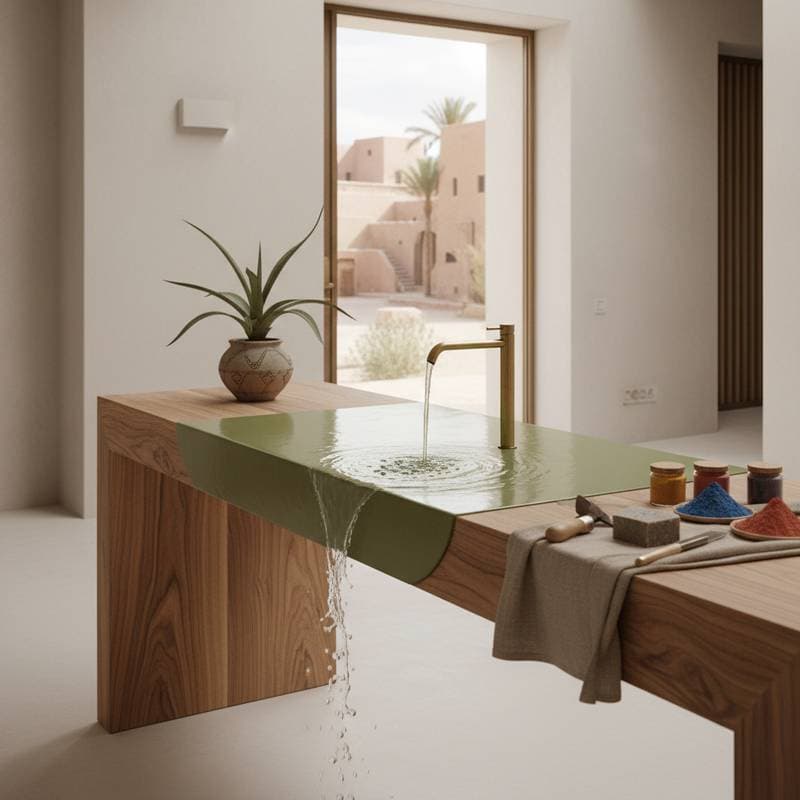
Tadelakt Plaster: Elevating Wood Finishes with Moroccan Heritage
Tadelakt plaster, an ancient Moroccan lime-based finish originally used in hammams and royal palaces, now enhances contemporary woodworking projects. This material delivers a seamless, breathable, and water-resistant layer that safeguards wood surfaces while imparting a subtle, stone-like luster. Woodworkers who value both artistry and longevity increasingly adopt tadelakt to create durable pieces that stand out in demanding environments.
Unique Properties of Tadelakt
Tadelakt differs from conventional synthetic sealers or polyurethane varnishes, which create inflexible films over wood. Instead, it bonds chemically via carbonation, forming a compact microstructure that repels moisture while permitting vapor transmission. Artisans polish the surface with a solution of natural soap, triggering a reaction with the lime to yield a soft, marble-esque sheen. The outcome is an organic appearance and a tactile warmth that invites touch.
Designer Elise Martin notes, “We were drawn to tadelakt for its depth and tactility. It protects wood without hiding its character.” This perspective explains the shift among finishers toward this time-honored technique for surfaces that harmonize strength with aesthetic appeal.
Application Process on Wood Substrates
While traditional tadelakt coats masonry, adaptations for wood involve pairing it with pre-sealed bases. Preparation proves essential: select dimensionally stable wood, sand to a fine smoothness, and apply a mineral primer for adhesion. Build the finish in several thin layers of lime plaster, each compacted using a flat stone tool to densify the material. Conclude by buffing with olive oil soap in gentle circles, achieving the characteristic velvety sheen and moisture resistance.
This method excels in moisture-prone settings, such as bathroom vanities, spa seating, kitchen range hoods, and cabinet panels adjacent to sinks or showers. Its vapor permeability mitigates risks of internal condensation, reducing chances of wood distortion or fungal growth.
Aesthetic and Design Advantages
Tadelakt imparts a rich interplay of color and texture unmatched by most commercial finishes. It exhibits a diffused radiance that varies under different lighting conditions, appearing softly matte in dim areas and subtly luminous in brighter spots. Available hues span from warm creams to intense terracotta reds and cool slate grays, achieved by incorporating earth-derived pigments into the lime base.
Over wood elements like cabinet doors or wall cladding, tadelakt softens the distinction between substrate and coating. Subtle wood grain patterns emerge faintly beneath the plaster, fostering a multidimensional, artisanal effect. Such versatility complements diverse styles, from cozy, textured rooms to sleek, pared-down designs emphasizing organic elements.
Operational Benefits for Woodworking Professionals
Tadelakt provides woodworkers with distinct practical edges in performance and production:
- Moisture management. The lime reacts with soap to generate calcium stearate, a compound that sheds water droplets while allowing underlying wood to release humidity.
- Ease of restoration. Minor abrasions respond to light abrasion with a moist cloth and soap, eliminating the need for complete reapplication.
- Eco-friendly profile. Composed of lime, fine marble powder, and plant-based soap, it releases negligible volatile organic compounds during and after curing.
- Extended durability. With periodic upkeep, the finish endures for generations, resisting wear from routine handling.
Master finisher Jordan Lee observes, “Once clients see that it resists water but still feels alive, they stop asking for plastic coatings. It’s a tactile upgrade.” This insight highlights its draw for makers prioritizing environmental responsibility and sensory quality.
Step-by-Step Application Guidelines
Success with tadelakt demands careful timing and technique. Allow each layer to cure gradually in a humid environment to avoid fissures. Burnish promptly after application to seal the surface, but delay final polishing until the plaster firms slightly to prevent uneven marks. Employ small, rounded stones or flexible trowels for compression, applying even pressure across the area.
Target a cumulative thickness of 1/8 inch, or 3 millimeters, distributing it evenly across coats. Ensure seamless transitions at edges, corners, and junctions, as tadelakt thrives in uninterrupted expanses that mimic a single, fluid membrane.
Essential Insights for Implementation
- Targeted uses. Ideal for humid-adjacent fixtures like lavatory cabinetry, beverage stations, and wellness area furnishings.
- Upkeep schedule. Refresh water resistance annually or biannually by reapplying a thin soap layer.
- Material compatibility. Pairs effectively with woods ranging from light oak to rich mahogany.
- Finish characteristics. Delivers a gentle sheen derived from natural processes, free of artificial gloss.
- Resilience factors. Tolerates frequent contact while preserving an authentic, crafted patina.
Advancements in formulation and preparatory compounds position tadelakt as a staple in premium woodworking by 2026. It aligns with rising preferences for heritage-inspired solutions that evolve beautifully over time.
Everyday Performance and Longevity
In active spaces, tadelakt demonstrates reliable functionality. Water contacts the surface and beads up for easy removal, while the material stays comfortably temperate to the touch. As years pass, a fine patina emerges, deepening tones without signs of deterioration. Homeowners benefit from features like stable vanity tops in steamy bathrooms or enduring kitchen surrounds that mature gracefully.
This finish underscores how revisiting proven methods can inspire progress. Simple elements—lime, pigments, water, and soap—yield a coating that bridges historical wisdom with modern expectations.