
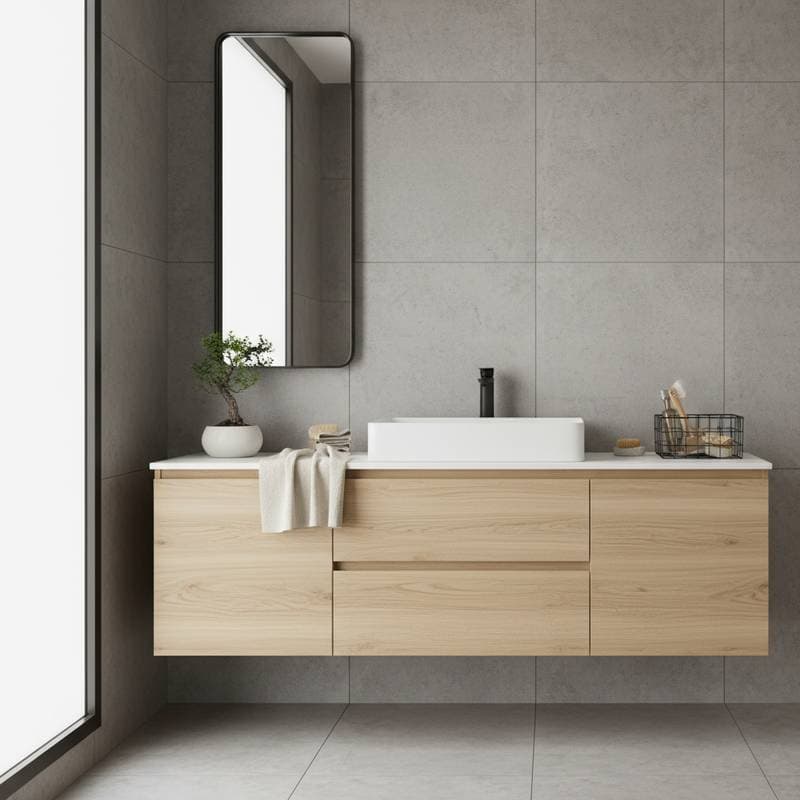
Key Materials: Solid wood or veneer plywood, concealed brackets, wall anchors, finish oil or clear coat
Design Style: Japandi, minimalist, natural tones
Understanding Japandi Design Principles
Japandi style merges Japanese minimalism with Scandinavian functionality, creating spaces that promote tranquility and efficiency. This approach favors clean lines, natural materials, and subtle warmth, which suit a floating vanity perfectly. The design elevates a bathroom by maximizing light and openness while providing essential storage.
Select materials that align with these principles. Opt for light woods like oak or birch to maintain an airy feel. Avoid ornate details; focus on smooth surfaces and integrated hardware that recedes into the background.
Gathering Materials and Tools
Assemble all necessary items before starting to ensure smooth progress. For the vanity structure, procure 3/4-inch plywood or solid wood boards in dimensions that match your planned size. You will need approximately 4 to 6 linear feet for sides and shelves, depending on width.
Essential tools include a circular saw or table saw for precise cuts, a drill with bits for pilot holes, a level for alignment, and clamps for securing pieces during assembly. For finishing, prepare sandpaper in grits from 120 to 220, along with brushes or rags for applying oil. Budget for screws, wood glue, and edge banding to cover plywood edges seamlessly.
Action step: Create a shopping list based on your sketch. Visit a local lumberyard to inspect wood quality, ensuring it is straight and free of knots that could weaken the structure.
Planning Dimensions and Layout
Precise planning prevents costly adjustments later. Begin by measuring the bathroom wall where the vanity will mount. Account for existing plumbing; standard sink drains require a 1.5-inch hole, positioned centrally.
Determine the vanity width based on space constraints. A 36-inch unit works well for most bathrooms, offering balance without overwhelming the area. Depth should measure 18 to 20 inches to allow comfortable access to the sink while preserving floor space.
Height from floor to countertop typically ranges from 32 to 34 inches, adjustable for user preference. Factor in the sink weight; vessel sinks add 15 to 30 pounds when filled. Use graph paper to draw a front, side, and top view, marking all cut lines and hardware placements.
Action step: Verify measurements against the actual space. Tape outlines on the floor and wall to visualize the final position and ensure it harmonizes with surrounding fixtures.
Cutting and Assembling the Vanity Box
With plans finalized, proceed to fabrication. This phase takes one to two days, depending on experience. Wear safety gear, including goggles and a dust mask, to protect against sawdust and debris.
Cut the plywood panels: two side pieces to full height and depth, a back panel slightly shorter for mounting clearance, and a bottom shelf for support. For a basic open-shelf design, include one or two internal dividers. Use a straightedge guide for accurate cuts, aiming for edges that are square and smooth.
Assemble the box using wood glue along joints, reinforced with 1.25-inch brad nails or screws. Clamp pieces together and allow glue to set for at least one hour. Add edge banding to exposed plywood edges, then sand the entire assembly progressively to achieve a silky finish.
Action step: Dry-fit all components before gluing to confirm alignment. Adjust as needed to ensure the box remains level and square, measuring diagonals to verify squareness.
Adding Functional Features
Incorporate storage and utility elements that enhance usability without cluttering the aesthetic. Install soft-close drawer slides if adding drawers; position them on the internal dividers for hidden support. For an open design, weave in slim baskets later for organization.
Drill holes for plumbing at the back of the bottom shelf, using a hole saw for clean circles. Test-fit the sink to confirm clearance. If including a backsplash, attach a thin wood strip along the upper rear edge before final assembly.
Apply the finish now for protection. Wipe on a thin layer of tung oil or Danish oil, allowing it to penetrate for 15 minutes before buffing off excess. Repeat two to three coats, sanding lightly between applications for an even, matte sheen.
Action step: Handle the wood gently during finishing to avoid dents. Let the final coat cure for 24 hours in a dust-free area before proceeding to installation.
Securing the Vanity to the Wall
Mounting demands careful preparation to ensure stability. Locate wall studs using an electronic finder, marking positions every 16 inches typically. The vanity requires attachment to at least three studs for loads up to 200 pounds.
Install heavy-duty French cleats or L-brackets rated for 300 pounds or more. Secure the wall portion to studs with 3-inch lag screws, pre-drilling to prevent splitting. If studs misalign, add a plywood blocking board between them, nailed securely before drywall patching if necessary.
Lift the vanity onto the cleats with assistance, ensuring it hooks firmly. Use a level to adjust shims behind the unit for plumb alignment. Tighten all fasteners gradually, checking for movement.
Action step: Apply firm pressure along the front and sides post-installation. The structure should remain rigid; reinforce if any flex occurs.
Integrating Sink and Plumbing
Connect the sink after mounting to minimize handling risks. Position the vessel sink centered on the countertop, tracing its base for a support ring if needed. Secure with silicone adhesive for a watertight seal.
Attach the faucet through pre-drilled holes, using washers and nuts underneath. Route supply lines and drain through the rear openings, connecting to existing plumbing. Tighten compression fittings hand-tight, then a quarter-turn with a wrench to avoid leaks.
Test the setup by running water slowly, checking for drips at all joints. Seal gaps around pipes with silicone caulk for moisture resistance.
Action step: Wipe down all surfaces and run a full cycle of hot and cold water. Address any issues immediately to prevent water damage.
Budget Considerations
This project scales with material choices, keeping costs manageable for DIY enthusiasts. Basic construction using birch plywood and standard hardware totals $400 to $600. Upgrading to solid oak and a quartz countertop elevates expenses to $1,000 or more.
Wood selection influences price significantly; pine offers affordability at $5 per board foot, while walnut reaches $15. Finishes like boiled linseed oil cost under $20 per quart, versus professional-grade polyurethanes at $50.
Plumbing modifications, such as relocating valves, add $200 to $400 if hiring a professional. Source remnants from salvage yards to trim waste and expenses.
Money-saving tip: Assemble the core structure yourself and outsource only specialized tasks like electrical outlet adjustments near the vanity.
Avoiding Pitfalls in Construction
Anticipate challenges to achieve a professional result. Uneven walls demand shimming; measure gaps at multiple points and use composite shims for stability.
Protect wood from humidity by sealing all edges, especially near water sources. Limit drawer contents to lightweight items, distributing weight evenly to prevent sagging.
Align plumbing meticulously; mock up the sink position with cardboard templates. Choose low-luster finishes to preserve the serene Japandi vibe, testing samples on scrap wood first.
Action step: Review the installation under varied lighting conditions. Correct any visible imperfections, such as uneven oil application, with targeted sanding and reapplication.
Maintaining and Enjoying the Vanity
Your completed vanity integrates seamlessly into daily routines, fostering a peaceful environment. The floating design simplifies floor cleaning; vacuum or sweep beneath without obstruction. Natural wood develops a patina over time, enhancing character if maintained with quarterly oil reapplications.
Organize toiletries in under-vanity baskets made from natural fibers, keeping surfaces clear for a minimalist appeal. This setup not only streamlines mornings but also amplifies the bathroom's sense of spacious calm, turning routine tasks into moments of quiet efficiency.