
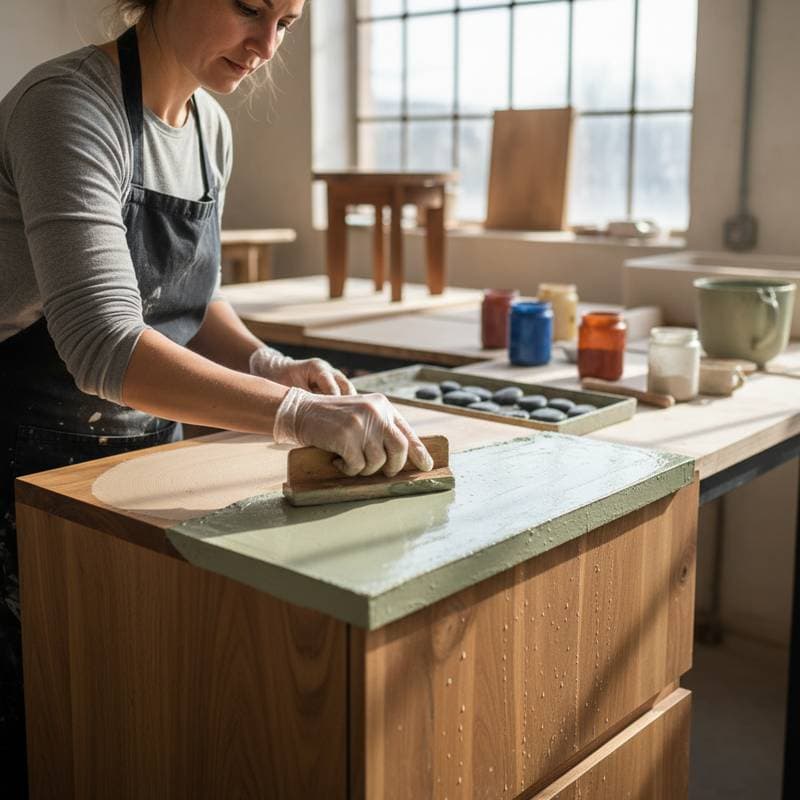
Tadelakt: The Timeless Moroccan Plaster for Waterproof Wood
A spilled beverage on a finely crafted walnut table risks more than surface damage. It threatens to penetrate the grain, cause swelling, and compromise extensive craftsmanship. While conventional sealants offer temporary protection, they degrade over time and require frequent renewal. Tadelakt, a traditional Moroccan lime plaster technique, provides a superior alternative. Originally employed to seal bathhouses and water features, this method now imparts enduring waterproof qualities to wood, yielding a stone-like resilience that accommodates natural expansion and contraction.
Key Features at a Glance
- Type: Mineral-based lime plaster finish
- Ideal Applications: Furniture, bathroom vanities, wall panels, countertops
- Cost Range: $10 to $20 per square foot for professional application
- Expected Durability: 20 years or longer with appropriate sealing
- Required Skill Level: Intermediate to advanced
The Unique Properties of Tadelakt
Tadelakt consists of lime plaster combined with marble dust and natural soap. Applied in successive thin layers and polished with a stone tool, it develops a robust chemical bond against moisture. The outcome is a tactile surface that combines softness with density, reminiscent of burnished leather. In contrast to synthetic sealants that create an impermeable plastic layer, tadelakt integrates seamlessly with the substrate, permitting vapor transmission while repelling liquid water.
This permeability proves essential for wood applications. Standard varnishes often fracture amid seasonal shifts in humidity. Tadelakt maintains flexibility, merging the impermeability of plaster with wood's inherent movement.
Core Mechanisms Behind Its Effectiveness:
- Lime interacts with fatty acids from olive soap to form calcium stearate, a inherent water-repellent compound.
- Marble dust enhances structural integrity and imparts a refined luster.
- Burnishing compacts the material, closing microscopic pores and fortifying moisture resistance.
After full curing, the finish endures for decades, necessitating only periodic reapplication of soap for upkeep.
Step-by-Step Application on Wood Surfaces
Preparation forms the foundation of successful tadelakt application on wood. Select smooth, clean surfaces with minimal texture to ensure adhesion. Species such as pine, oak, and maple perform reliably; for oily woods like teak, thorough degreasing becomes necessary.
Detailed Application Process:
- Apply a Bonding Primer: Use a mineral-based primer to promote adhesion and avert separation between layers.
- Spread the Initial Layer: Employ a flexible trowel to distribute lime plaster at approximately 1 millimeter thickness. Allow it to firm up before proceeding.
- Layer and Compress: Add a subsequent coat and level it with a plastic float or trowel for uniformity.
- Burnish for Sheen: As the surface begins to set, rub with a river stone to generate the characteristic glossy finish through frictional heat.
- Seal with Soap Solution: Distribute an olive soap mixture in circular patterns to initiate the waterproofing reaction.
Drying periods depend on ambient humidity, typically requiring two days before final sealing. Allocate at least one week prior to subjecting the surface to prolonged moisture exposure.
Budgeting for Tadelakt Projects
Professional tadelakt services on wood generally range from $10 to $20 per square foot. For do-it-yourself efforts, costs may descend to $4 to $8 per square foot, assuming access to essential tools and bulk purchases of materials. Primary expenditures encompass premium hydrated lime, marble flour, olive soap, and labor investment.
Influencing Cost Variables:
- Design Complexity: Intricate contours and details extend burnishing time.
- Coat Thickness: Greater depth consumes additional material yet bolsters longevity.
- Professional Fees: Experienced applicators charge higher rates for superior outcomes.
Strategies to Control Expenses:
- Test techniques on wood offcuts to refine skills without waste.
- Incorporate powdered pigments for customized hues at lower cost than premixed options.
- Maintain and repurpose burnishing stones for multiple uses.
The concluding soap application remains non-negotiable, as it activates the waterproof properties beyond mere aesthetics.
Choosing Between DIY and Professional Services
Individuals proficient in plaster work and detail-oriented tasks may undertake tadelakt application independently. The hands-on process offers satisfaction, though corrections prove challenging once layers harden.
Essential DIY Preparation:
- Assemble plastering tools, mixing containers, and safety equipment.
- Source pure lime plaster, marble dust, olive soap, and a polished river stone.
- Wear gloves and protective eyewear to handle alkaline materials safely.
Reserve this technique for those with intermediate to advanced capabilities. For valuable items or moisture-intensive areas like bathroom fixtures, professional intervention ensures optimal results. An expert can finish a compact vanity in three days, whereas self-directed projects often span a week.
When engaging specialists, confirm expertise in authentic Moroccan plaster methods. Request visual examples of prior work and verify use of lime-based formulas free from cement additives. Genuine tadelakt retains alkalinity, promoting ongoing hardening.
Avoiding Pitfalls in Tadelakt Work
Precision and deliberation define successful tadelakt outcomes. Haste at any phase invites structural weaknesses.
Prevalent Application Errors:
- Omitting the Primer: Results in plaster detachment from the wood base.
- Excessive Moisture in Burnishing: Leads to surface softening and uneven marks.
- Incorporating Synthetic Additives: Impedes the essential lime-soap interaction and compromises permeability.
- Insufficient Soap Treatment: Fails to establish full water resistance.
Should imperfections like matte areas or powdery buildup appear, address them by re-polishing with a moistened cloth and minimal soap. A properly executed finish exhibits silkiness and immediate water beading.
Ensuring Longevity Through Care
Established tadelakt surfaces demand minimal intervention. Address spills without delay and cleanse using a mild olive soap dilution, steering clear of harsh cleaners. Rejuvenate the protective barrier quarterly with a gentle soap application to sustain repellency. Refrain from abrasive tools that might diminish the polish.
Over years, tadelakt evolves aesthetically, with hues intensifying and nuances emerging to evoke artisanal mastery unattainable by synthetic alternatives. The material remains thermally neutral and inherently antimicrobial, thanks to its elevated pH level, deterring fungal growth in humid environments.
This enduring finish not only safeguards wood investments but also enhances their visual and tactile appeal, delivering practical waterproofing alongside timeless elegance.