
Tadelakt Plaster: A Waterproof Alternative to Wood in Kitchens and Baths
Tadelakt plaster transitions from traditional Moroccan settings to contemporary kitchens and bathrooms. This material delivers the seamless warmth associated with wood, yet it avoids issues such as swelling, splitting, or mold growth. Woodworkers and finishing experts find it a practical option that withstands water exposure while preserving natural depth and texture.
Project Overview
Homeowners: Two adults who appreciate natural materials
Location: Coastal townhouse
Size: 1,850 square feet (171.9 square meters)
Design Team: Atelier Noma Design
Photographer: Claire Vane
Before the Renovation
The bathrooms and kitchen previously depended on sealed oak and marine varnish to combat humidity. The wood appeared rich initially, but it demanded sanding and resealing every few months. Steam caused cabinet faces to warp, and vanity edges darkened due to trapped moisture. Homeowner Elise Tran noted, "We wanted to keep the organic look but stop fighting the upkeep." Tight corners and persistent humidity prompted the team to seek a waterproof finish that retained a handcrafted feel.
After the Renovation
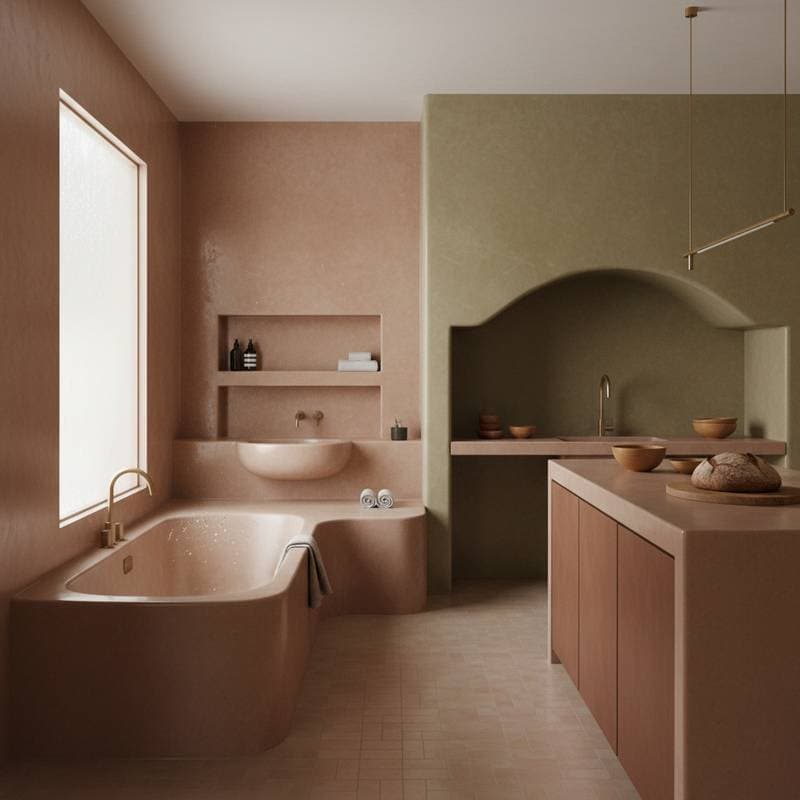
The key change involved substituting wood paneling and veneer with hand-polished tadelakt plaster. Designer Mateo Ruiz explained that the objective was "to keep the softness of wood grain but gain the permanence of stone." The plaster now envelops the vanity, backsplash, and shower enclosure in a continuous layer, free of joints or caulk lines. Light glides across the subtle curves, accentuating brush marks and burnished surfaces.
This transformation extended beyond surface durability. It streamlined the layout, allowing the eye to move uninterrupted from counter to wall without trim or seams. Storage niches integrated directly into the plaster minimize clutter. LED strips concealed in reveals reflect off the lime surface, creating a warm, subtle glow reminiscent of candlelight.
Design Specifications
- Material: Traditional lime-based tadelakt plaster sealed with olive soap
- Color: Custom blend of ivory and pale sand, offering a matte finish with gentle reflection
- Application Thickness: Approximately 0.25 inches (6 millimeters) applied over a cement substrate
- Tools: Flexible steel trowels, stone polishing pebble, and natural sponge
- Lighting: Integrated LED ribbon lights positioned behind plaster reveals and under floating shelves
- Storage Solutions: Built-in niches measuring 12 inches (30 centimeters) deep, lined with matching plaster for seamless continuity
- Maintenance: Periodic buffing with an olive soap solution to maintain the water-resistant barrier
These elements reinforce the principle of continuous surface flow. The visual serenity evident in the photographs arises from the lack of visible cuts or transitions. The plaster molds into corners, creating soft edges that mimic hand-shaped wood while providing stone-like resilience.
Performance in Humid Environments
Tadelakt consists of lime plaster that undergoes compression and polishing to seal its pores. The surface receives a treatment with natural soap, which reacts with the lime to produce calcium stearate. This process creates a barrier against water while permitting vapor to pass through. Consequently, it forms a breathable, waterproof coating that deters mildew without relying on synthetic sealants.
In areas prone to moisture where wood expands or delaminates, tadelakt remains dimensionally stable. It also eschews the chilly sensation of tile. Upon contact, the wall feels smooth yet not slippery, retaining a slight warmth from the surrounding air temperature. This tactile appeal suits showers, backsplashes, and tub surrounds, where organic character proves desirable without associated risks.
Tadelakt Versus Wood
Wood endures as a preferred choice for its distinctive grain, inherent warmth, and artisanal qualities. However, in sustained humidity, even superior finishes falter. Clear coatings eventually fracture, joints separate, and dimensional shifts become apparent at seams. Tadelakt circumvents these drawbacks through its monolithic nature. After complete curing, it functions as a unified layer impervious to moisture-induced expansion.
For woodworkers, this represents a departure from convention, yet it unlocks fresh possibilities. Rather than battling water, integrate the materials strategically. Apply tadelakt in high-splash areas, then accentuate it with wood trims or open shelves beyond the wet zones. The plaster's soft matte texture complements oiled walnut or ash effectively.
Application Techniques
Tadelakt application demands precision and careful timing. The plaster builds up in thin layers, with each compressed during setting. Premature handling causes tearing, while delayed polishing hinders the finish. The concluding polish with a stone pebble imparts the characteristic sheen. Ruiz likened it to "a finish that rewards rhythm and touch."
Professionals allocate two to three days of hands-on work for a modest bathroom. Material expenses range from fifteen to twenty dollars per square foot, comparable to premium hardwood paneling. The underlying substrate requires stability, flatness, and avoidance of gypsum. Cement board or lime render serves optimally. Given its vapor permeability, tadelakt integrates seamlessly with radiant heating systems in walls or floors.
Practical Guide for Home Application
- Prepare a sample board to practice compression and polishing timing.
- Incorporate rounded corners instead of sharp edges, as the material adheres best to curves.
- Employ only natural soaps like olive or black for upkeep to sustain the chemical seal.
- Integrate lighting from the outset, favoring recessed or indirect sources to reveal texture and color depth.
- Pair with complementary elements such as wood shelving or stone counters to enhance visual framing.
These guidelines make tadelakt accessible for modest undertakings, including vanity backsplashes, shower niches, or fireplace surrounds.
Essential Benefits
Tadelakt strikes an uncommon equilibrium between aesthetic appeal and functional reliability. It conveys handcrafted elegance while enduring water exposure that would compromise wood finishes. Designers value its promotion of continuity and tranquility. Builders appreciate the reduction in joints and trim work. Homeowners benefit from diminished maintenance demands.
Consider splash-prone areas as primary candidates. Shower walls, bath surrounds, and kitchen backsplashes gain from the seamless coverage. Extend the application marginally beyond wet zones to foster visual cohesion. Combine with warm metals or light woods to prevent a stark atmosphere.
In the townhouse renovation, the plaster elevated spatial dynamics beyond mere waterproofing. Morning sunlight now skims curved walls, casting soft, fluid shadows. Cleaning requires only a damp cloth and mild soap, eliminating sanding, varnishing, or swelling concerns.
Care and Longevity
Tadelakt, as a natural finish, responds well to attentive handling. Renew the olive soap solution application once or twice annually to restore sheen. Steer clear of abrasive cleaners. Minor scratches yield to gentle buffing with a soft cloth. The mineral composition allows color variations to evolve, developing a patina akin to aged wood.
Homeowners frequently characterize it as a dynamic surface. It captures interactions with touch and light rather than concealing them. With time, it grows more radiant rather than fading. For active households, this translates to a resilient material that preserves its allure amid routine use.
Project Credits
Design Team: Atelier Noma Design, Mateo Ruiz, Principal Designer
Homeowners: Elise and Daniel Tran
Photographer: Claire Vane
Though rooted in ancient tradition, tadelakt aligns with modern needs. Where wood once faltered, this Moroccan plaster provides a subtle, lasting solution.