
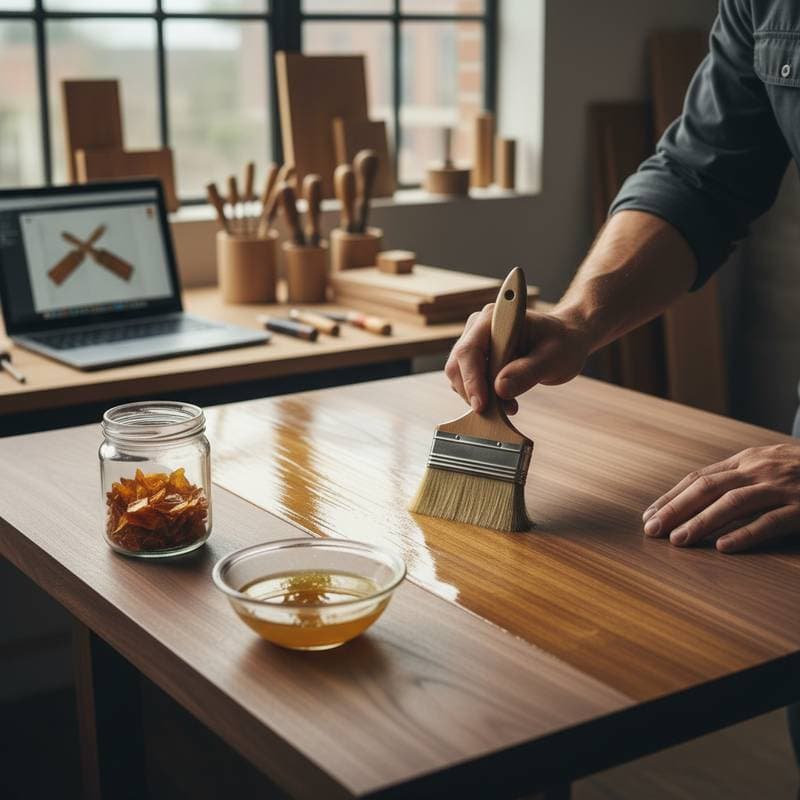
Why Shellac Flakes Are Resurging in Wood Finishing
Shellac flakes, a traditional staple in fine furniture finishing, are regaining prominence in contemporary workshops. This resurgence stems from more than sentiment; it arises from the precision, transparency, and direct connection shellac provides between artisan and wood surface.
Quick Overview
Type: Natural resin-based finish
Primary Applications: Sealer, topcoat, or isolating layer
Source Material: Resin secreted by the lac bug, processed into dry flakes
Preparation and Use: Dissolve flakes in denatured alcohol; apply via brush, padding, or spraying
Image Credit: Studio Woodline
The Shift Away from Shellac
For several decades, shellac yielded to polyurethane and water-based alternatives. Production demands favored these options for their rapid application and robust longevity. Workshops adopted high-solids formulas that required minimal layers and quick curing, streamlining operations in larger settings.
However, these modern finishes introduced compromises in visual appeal and ease of maintenance. Furniture maker Lisa Horton observes, “Shellac was treated like an antique. People forgot how adaptable it could be.” In smaller studios, the practicality of synthetic coatings often diminished the warmth and reversibility that shellac delivers.
The Current Revival
Shellac flakes now return to workbenches for compelling practical and visual reasons. Freshly prepared solutions yield exceptional clarity and depth on bare wood. The finish accumulates swiftly, sets in minutes, and sands smoothly between applications. Its alcohol solvent allows straightforward correction of imperfections like dust particles or runs.
Professionals appreciate the renewable origin and minimal toxicity of shellac. As a sealer beneath oils or varnishes, it stabilizes color and averts uneven absorption. Employed alone, shellac accentuates wood figure and grain without obscuring tactile qualities.
Finisher Paul Nguyen explains, “Shellac gives me control. I can mix it thin to pop the grain or thicker for a French polish look. It behaves exactly how I make it behave.” His recent walnut panels demonstrate this mastery, with successive thin layers burnished to a subtle luster that captures light dynamically.
Practical Application Guide
Selecting Flake Varieties
Shellac flakes come in options such as orange, blonde, super blonde, and garnet. These provide tones from warm amber to almost colorless clarity. Choose blonde for light woods like maple to preserve brightness in cabinetry or built-in features. Opt for garnet on mahogany to evoke timeless depth in heirloom pieces.
Preparing the Mixture
Standard ratios involve one to three pounds of flakes per gallon of denatured alcohol, equivalent to 0.12 to 0.36 kilograms per liter. Thinner mixtures penetrate wood fibers more effectively and self-level during drying. Prepare only the volume required for immediate use to maintain potency; store excess flakes in airtight containers away from moisture.
Tools and Techniques
Use natural-bristle brushes for broad coverage, cotton pads for nuanced blending, or HVLP sprayers for even distribution. Padding with an alcohol-dampened cloth seamlessly merges edges on contoured surfaces. Apply in a dust-free environment, working in thin passes to avoid buildup.
Building Layers
Start with two to four coats to form a level foundation. Each subsequent layer enhances sheen and durability. Between coats, sand lightly with 320-grit paper to refine the surface. Allow 30 minutes to one hour between applications, depending on ambient humidity.
Repair and Upkeep
Damaged areas respond well to localized renewal. Wipe with denatured alcohol to soften the existing film, then feather in fresh material. This approach integrates repairs without visible seams, extending the finish's life indefinitely.
These methods adapt to project scale. For a kitchen table, a super blonde cut ensures clean, modern aesthetics. In restoration, an orange variant harmonizes with aged patinas.
Relevance in Today's Woodworking
The woodworking community increasingly values natural, low-environmental-impact materials. Shellac aligns seamlessly with this ethos: it biodegrades fully, poses no toxicity risk after curing, and avoids synthetic additives. Preparing from flakes ensures optimal freshness and reduces waste from premixed products.
Versatility further enhances its appeal. As a barrier, shellac separates conflicting finishes, such as preventing dye migration into topcoats. In conservation, it preserves authentic textures while bolstering resilience.
This revival does not dismiss synthetic advances. Rather, it equips artisans with targeted solutions. Instrument makers, custom fabricators, and restorers benefit from shellac's balance of accuracy and simplicity.
Essential Benefits
- Customization: Prepare mixtures to dictate viscosity, hue, and open time precisely.
- Restoration Ease: Reactivate with alcohol for flawless, nondestructive repairs.
- Eco-Alignment: Sourced renewably, it supports sustainable workshop practices.
- Visual Excellence: Delivers superior transparency and tonal warmth for premium surfaces.
- Process Speed: Rapid setting and sanding enable efficient, multi-coat workflows.
To integrate shellac, begin modestly. Procure dewaxed flakes for broad compatibility, blend a small batch, and test on scrap pieces. Observe how illumination interacts with each layer. This hands-on exploration reveals the enduring draw for seasoned practitioners.
Maintaining the Finish Over Time
Cured shellac requires straightforward preservation. Clean routinely with a soft cloth dampened in mild soap solution. Steer clear of prolonged moisture or temperatures exceeding 140 degrees Fahrenheit, or 60 degrees Celsius, to prevent softening.
When abrasion occurs, address it promptly. Apply a targeted renewal coat to revive the original radiance, bypassing full removal. This method sustains the finish's integrity across years of use.
Shellac's resurgence underscores a core principle: refined techniques and natural media yield superior outcomes. Woodworkers who embrace it gain a versatile ally for projects that honor both heritage and innovation.
Insights from Experts
Design perspectives drawn from furniture maker Lisa Horton.
Technical advice provided by finisher Paul Nguyen.