
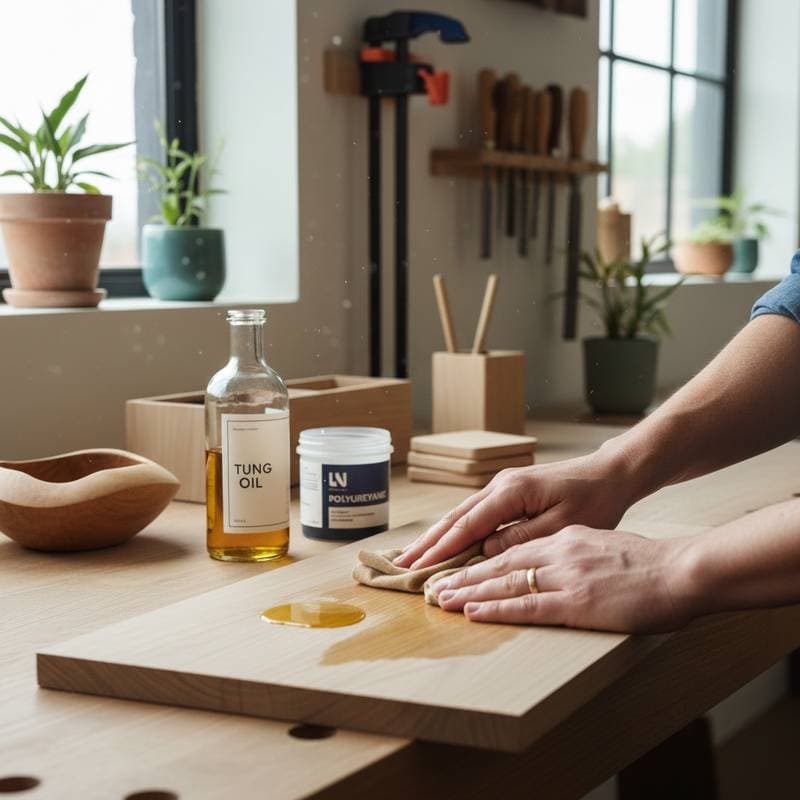
Tung Oil's Resurgence: Outshining Polyurethane in Woodworking
Tung oil, a longstanding choice among furniture makers and finishers, experiences renewed popularity in workshops nationwide. Woodworkers increasingly select finishes that allow wood to breathe, expand, and develop a patina alongside the material. This transition stems from practical advantages in control, ease of repair, and a tangible link between artisan and wood.
At a Glance
Project Type: Natural wood finishing trend
Key Materials: Pure tung oil, polymerized tung oil blends, mineral spirits, citrus solvent
Used For: Furniture, cabinetry, cutting boards, floors, turned pieces
Design Teams Interviewed: Prairie Bench Studio, Grove & Grain Works, artisan finisher Laura Chen
Photography: Courtesy of Grove & Grain Works
Before
Polyurethane held dominance for years due to its durable, protective layer. This coating effectively blocked moisture and abrasion, essential for high-traffic areas like kitchens and living spaces. However, the film created a barrier that distanced users from the wood's inherent qualities. With time, the shine often yellowed, chipped, or flaked, necessitating complete sanding to bare wood for any refinishing.
One woodworker observed, “It looked perfect the day I sprayed it, but a year later it felt like plastic. I wanted the piece to look alive again.”
After
Contemporary applications feature tung oil on workbenches, tabletops, and built-in elements. The transformation appears in both visual appeal and tactile response. Rather than forming a heavy topcoat, tung oil permeates the fibers, solidifies internally, and imparts a subtle sheen that intensifies through successive layers. Light interacts with the surface by highlighting the grain instead of bouncing off an artificial gloss.
Recent images from Grove & Grain Works capture a walnut dining table with a subdued matte radiance. The finish accentuates fine pores and intricate grain patterns. No artificial overlay is evident; instead, the wood appears revitalized and conditioned. The team used five hand-applied coats, each diluted with citrus solvent to enhance absorption. Light buffing with a white pad between applications ensured uniform texture.
Designer Laura Chen noted, “The goal is to make the finish disappear. You feel the wood, not the product. That’s what makes it timeless.”
Design Details
- Application: Apply thin layers by wiping or brushing until absorption ceases. Allow each layer to cure for a minimum of twenty-four hours prior to the subsequent one.
- Build: Employ three to six coats for furniture; extend to ten coats for floors or tabletops to achieve greater depth.
- Blend Options: Select pure tung oil for food-contact surfaces; opt for polymerized variants to accelerate drying and increase luster.
- Sheen Control: Use 0000 steel wool for buffing to a satin finish, or burnish with a cotton cloth to attain minimal gloss.
- Maintenance: Reapply a light coat every few years. Sanding remains unnecessary except to address uneven wear.
These techniques yield a multifaceted finish that integrates seamlessly with the wood. Beyond aesthetics, the elastic nature of the cured oil accommodates seasonal humidity fluctuations, minimizing chances of cracks or separation.
Why It Matters
Interest in tung oil aligns with a larger push toward low-VOC, repair-friendly finishes. Professionals and enthusiasts alike challenge the reliance on synthetic barriers that immobilize the surface. Sourced from tung tree seeds, the oil undergoes natural polymerization upon air exposure, establishing a moisture-resistant shield within the fibers rather than atop them.
This internal fortification proves invaluable for heirloom-quality items. A minor scratch requires only a few drops of oil rubbed in to revive the luster. No extensive sanding, chemical stripping, or overspray is involved. Such simplicity attracts both novice hobbyists and established studios.
Laura Chen added, “Clients want furniture they can live with, not tiptoe around. Tung oil makes that possible. It wears slowly and beautifully.”
Comparing Tung Oil and Polyurethane
| Feature | Tung Oil | Polyurethane |
|---|---|---|
| Finish Type | Penetrating, flexible | Surface film, rigid |
| Repair | Spot repairable | Requires sanding and recoating |
| Appearance | Natural, low sheen | Glossy or semi-gloss |
| VOC Content | Low to none | Moderate to high |
| Durability | Builds gradually, ages well | Hard but prone to chipping |
| Touch and Feel | Warm, tactile | Slick, sealed |
The comparison highlights a clear distinction. Tung oil preserves the wood's authentic character, while polyurethane imposes an external sheen.
Practical Bridge: How to Try It at Home
For those interested in adopting this approach, begin with a modest project. Success depends more on deliberate care than specialized tools.
- Choose the right oil. Pure tung oil delivers the purest aesthetic. Polymerized tung oil incorporates pre-treated resins for quicker curing times.
- Prep carefully. Sand progressively to 220 grit. Vacuum thoroughly and wipe with a damp cloth to eliminate residual dust.
- Thin the first coat. Combine one part tung oil with one part solvent for optimal penetration. Distribute evenly using a lint-free cloth.
- Wipe off excess. After twenty minutes, clear away any unabsorbed oil to prevent tacky spots.
- Let it cure. Allow a full day before the next application. Continue until the wood exhibits consistent radiance.
- Buff and protect. Following the last coat, permit several days of curing before introducing use.
Successive layers accumulate density inside the grain structure, avoiding surface buildup. Saturation is achieved when additional oil no longer alters the wood's color.
Key Takeaways
- Tung oil finishes permit wood to expand and contract naturally, averting cracks from environmental shifts.
- Renewal occurs on-site without sanding or stripping.
- The coating amplifies grain visibility and sensory appeal without concealment.
- Its low-VOC profile and plant-based source support sustainable practices in home and professional settings.
- Methodical application yields superior warmth and endurance.
Grove & Grain Works indicates that clients now specify oil finishes for almost half of their projects. They emphasize the inviting surface texture and the subtle patina that emerges through regular interaction.
Maintaining Your Investment
Preserve the finished piece by cleaning with a dry or lightly damp cloth. Steer clear of silicone-containing polishes. Periodically, every few years, introduce a single thin coat of tung oil, allow twenty minutes for absorption, and wipe away residue. This routine sustains vibrant color and moisture resistance.
Sources or Credits
Interviews with Prairie Bench Studio, Grove & Grain Works, and Laura Chen. Photography courtesy of Grove & Grain Works.