
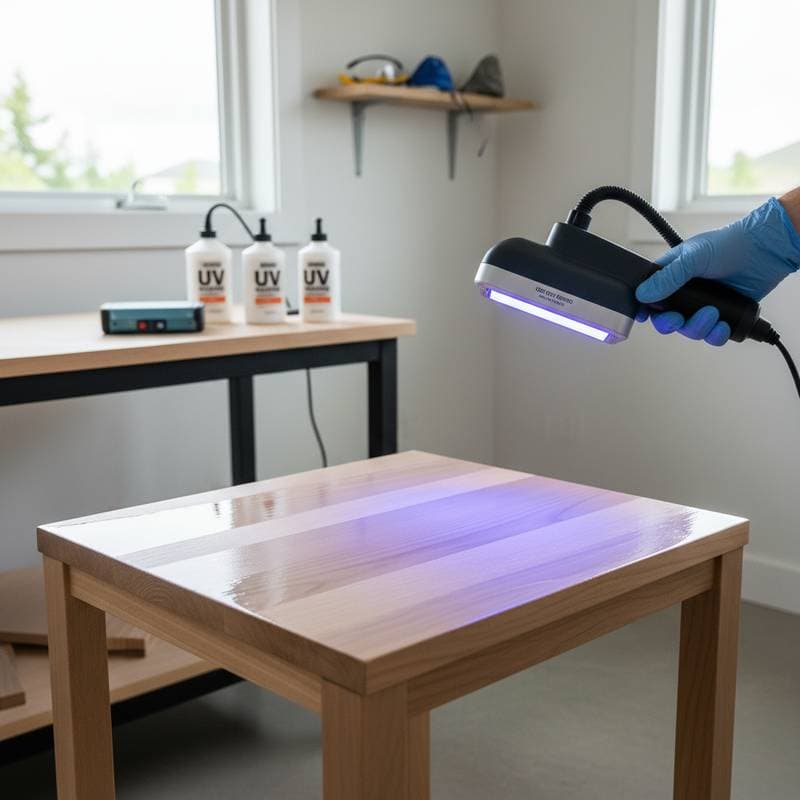
Fast-Cure UV Finishes Revolutionize Home Workshops
A clear coat that hardens in seconds may seem extraordinary, yet UV-cured wood finishes achieve exactly that. These coatings rely on ultraviolet light to initiate a chemical reaction, solidifying the surface almost immediately. Home woodworkers benefit from reduced project timelines, as tasks that previously required days now fit within an afternoon. The outcome includes smoother constructions, quicker completions, and improved shop air quality.
At a Glance
| Feature | Typical UV Finish | Traditional Finish |
|---|---|---|
| Cure time | 5 to 15 seconds | 8 to 48 hours |
| VOC level | Under 50 g/L | 200 to 500 g/L |
| Durability | 2 to 3 times harder | Standard |
| Cost per quart | $25 to $45 | $15 to $30 |
| Application method | Spray or roll, UV lamp required | Brush, wipe, or spray |
Why Fast-Cure UV Finishes Matter
Waiting overnight for a topcoat to dry often delays woodworking projects. UV finishes incorporate photo initiators that respond to ultraviolet light, creating a crosslinked polymer film in mere seconds. This rapid curing allows sanding, recoating, and assembly all on the same day, without concerns over sticky layers.
Air quality represents another key benefit. Waterborne UV finishes maintain volatile organic compound levels below 50 grams per liter, far lower than the hundreds found in solvent-based alternatives. Such formulations produce minimal odor and fumes, supporting safe use in enclosed spaces like garages or basements with standard ventilation.
Professionals have utilized UV coatings for years in industrial settings. Developments in waterborne formulations and compact LED lamps now extend these capabilities to home workshops, delivering comparable performance.
Action step: Begin with a modest project, such as a cutting board or cabinet door, to refine your technique. The evident speed and clarity will encourage progression to larger furniture pieces.
How the Process Works
The UV curing process unfolds in three straightforward stages.
- Apply the finish. Use a spray or roller to distribute a thin, uniform layer, aiming for 3 to 5 mils in wet thickness.
- Flash off moisture. Allow 5 to 10 minutes for the water carrier to evaporate fully.
- Expose to UV light. Guide the surface beneath a UV lamp or sweep a handheld LED unit steadily over the workpiece.
The coating solidifies upon absorbing the necessary light energy, typically 1.5 joules per square centimeter. The resulting surface accepts immediate sanding for subsequent layers.
This method offers precise control, preventing dust issues and minimizing corrections. Environmental factors like humidity or temperature no longer dictate finish consistency.
Action step: Select a UV LED curing lamp designed for coatings, avoiding those intended for adhesives. Ensure wavelengths fall between 365 and 395 nanometers to align with common waterborne UV finishes.
Cost and Budget Planning
Setting up for small-scale UV finishing proves more affordable than anticipated. Essential components include a quart of waterborne UV finish, a compact lamp, and basic accessories.
- Waterborne UV finish: $25 to $45 per quart, sufficient for 100 to 150 square feet.
- UV LED curing lamp: $400 to $800 for handheld or panel models.
- Safety gear: UV-protective goggles and gloves, totaling about $40.
- Miscellaneous tools: Spray gun or foam roller, drying rack, and sandpaper, approximately $100 in total.
Solvent-based systems often demand additional infrastructure, such as spray booths or explosion-proof fans, escalating expenses. UV setups center investment on the lamp itself.
For woodworkers completing several furniture items monthly, time efficiencies recoup equipment costs within one season. Energy use also decreases, as extended drying and forced air circulation become unnecessary.
Money-saving tip: Collaborate with fellow woodworkers or a community shop to share a curing lamp. These units frequently last over 10,000 hours.
DIY or Professional Options
Home enthusiasts secure strong outcomes through meticulous preparation and suitable equipment. Uniform coating and reliable light exposure form the foundation of success.
DIY Approach
Individuals experienced with spraying or rolling waterborne coatings find UV finishing accessible. The process features a brief learning period and tolerance for adjustments, as the finish stays pliable until light exposure. Handheld lamps suffice for compact items like tabletops or shelves.
Professional Services
Large-scale projects, including built-ins or commercial cabinetry, benefit from shops equipped with conveyor systems for even coverage. These facilities employ high-intensity lamps capable of curing thicker layers in one pass.
Selecting a Finishing Service
When delegating work, verify the provider employs waterborne UV finishes to minimize VOCs. Inquire about specific brands, such as Renner, ICA, or Sherwin-Williams UltraCure. Obtain a sample panel to evaluate hardness and gloss prior to full commitment.
Action step: Cure a finish sample on scrap wood to assess compatibility between your lamp and coating before tackling a complete project.
Common Mistakes to Avoid
Practice renders UV finishing straightforward, though certain pitfalls produce inconsistent results.
- Skipping flash time: Curing prior to water evaporation risks subsurface bubbles.
- Uneven lamp passes: Excessive speed creates under-cured areas that remain soft.
- Insufficient safety gear: Unprotected exposure to UV light irritates skin and eyes; use rated goggles and gloves consistently.
- Thick coats: Opt for thin applications in multiple layers to enhance clarity and adhesion.
- Wrong wavelength: Mismatched lamps fail to activate the finish chemistry; consult manufacturer specifications.
Action step: Employ a timer or metronome application to regulate lamp movement speed. Uniform passes guarantee consistent hardness and gloss.
Resources for Success
Visual aids support effective UV finishing implementation.
- Diagram: Depict the sequence of application, flash-off, and exposure.
- Chart: Compare waterborne UV finishes by brand and viscosity.
These tools clarify procedures and highlight product variations, aiding informed decisions.
Realizing Long-Term Benefits
Adopting UV-cured finishes elevates workshop efficiency and output quality. Projects progress swiftly, yielding durable surfaces with reduced environmental impact. As familiarity grows, woodworkers unlock creative potential, producing professional-grade pieces with greater ease and satisfaction.