
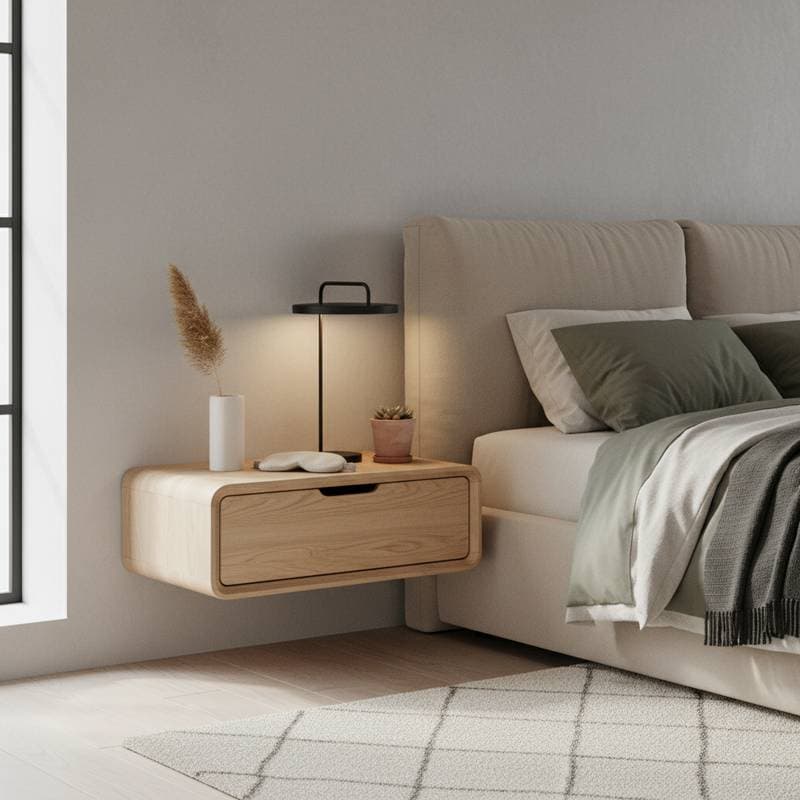
Introduction to Japandi Nightstands
Japandi design fuses Japanese minimalism with Scandinavian warmth, creating furniture that emphasizes clean lines, natural materials, and functional simplicity. In 2025, these nightstands stand out in DIY projects for their serene aesthetic and practicality. Ideal for small spaces, the floating style lifts the piece off the floor, fostering an airy feel while offering essential storage.
This guide equips you with everything needed to construct a pair of these nightstands for under $150 total. Focus on sustainable plywood and simple joinery to keep costs low without sacrificing quality. The result delivers a timeless bedroom upgrade that supports mindful living.
Key Design Principles
Japandi prioritizes balance and restraint. Opt for soft curves over sharp edges, and select muted tones like natural wood or pale stains. The floating mount creates visual lightness, while a single drawer provides discreet organization.
Dimensions typically measure 18 inches wide, 16 inches deep, and 20 inches tall for bedside use. This scale suits standard mattresses and allows comfortable access. Incorporate subtle details, such as rounded corners, to soften the profile and align with the philosophy of wabi-sabi, which celebrates imperfection.
Materials List
Gather these items for two nightstands, keeping the budget under $150:
- One 4-by-8-foot sheet of 3/4-inch birch plywood ($50): Use for tops, sides, and bottoms.
- One 4-by-4-foot sheet of 1/4-inch plywood ($20): For drawer bottoms and backs.
- 10 linear feet of iron-on edge banding in matching wood tone ($10).
- One pair of full-extension drawer slides, 12 inches long ($15): Soft-close models enhance usability.
- Wood glue and 1-1/4-inch pocket screws (50 count, $8).
- Brad nails or 3/4-inch screws for drawer assembly ($5).
- Matte polyurethane or Danish oil finish ($15): Choose water-based for easy cleanup.
- Sandpaper (180 and 220 grit, $5) and miscellaneous hardware like screws for mounting ($12).
Total estimated cost: $140. Source materials from local lumber yards or online suppliers for best value. Prioritize FSC-certified plywood to support sustainability.
Tools Required
Assemble these basic woodworking tools:
- Circular saw or table saw for ripping panels.
- Clamps (at least four bar clamps) and a framing square for alignment.
- Orbital sander with 180-grit and 220-grit paper for smoothing.
- Drill with driver bits and pocket-hole jig for joinery.
- Paintbrush or lint-free cloth for applying finish.
If you lack a table saw, a circular saw with a straightedge guide works well for straight cuts.
Step-by-Step Building Instructions
Follow these steps to construct one nightstand; repeat for the second. Allow 4-6 hours total, plus drying time.
Step 1: Cut the Panels
Rip the 3/4-inch plywood into two tops (18 by 16 inches), four sides (16 by 20 inches), and two bottoms (18 by 14 inches). From the 1/4-inch plywood, cut two drawer bottoms (15 by 13 inches) and two backs (17 by 5 inches). Maintain tolerances within 1/32 inch using a sharp blade and marked guides. Accurate cuts prevent alignment issues in the floating box.
Step 2: Assemble the Box
Drill four pocket holes along each end of the bottom panel. Spread wood glue on the edges, position the sides perpendicular to the bottom, and drive screws to secure. Attach the top similarly. Use clamps to hold pieces square; verify with a framing square before glue cures, which takes about 30 minutes.
Step 3: Construct the Drawer
Cut four drawer sides: two at 15 by 5 inches and two at 13 by 5 inches from 3/4-inch scraps if available, or purchase extra. Join with butt joints using glue and brad nails. Fit the 1/4-inch bottom flush inside, securing with nails. Add the back panel at the top edge. Sand all surfaces to remove sharp edges and ensure smooth drawer action.
Step 4: Install the Drawer Slide
Position the slides 4 inches from the bottom inside the box, flush with the front and side faces. Secure with provided screws. Insert the drawer and adjust for a 1/16-inch gap on sides and top. Attach the drawer face (cut to 17 by 6 inches from plywood) after testing fit; use double-sided tape initially for alignment, then screw from inside.
Step 5: Add Edge Banding and Finish
Apply iron-on edge banding to all exposed plywood edges using a household iron on medium heat. Press firmly, trim excess with a utility knife, and sand lightly with 220-grit paper. Brush on two thin coats of matte polyurethane, sanding lightly between coats, or apply three coats of Danish oil with a cloth, allowing 4-6 hours drying per coat. This protects the wood while preserving its natural grain.
Step 6: Mount the Floating Bracket
Craft a French cleat from scrap plywood or purchase a heavy-duty metal bracket rated for 50 pounds. Locate wall studs using a stud finder, spacing 16 inches apart. Secure the cleat to studs with 3-inch lag screws. Hang the nightstand by sliding the box onto the cleat, ensuring level placement. Set the top surface 20-24 inches from the floor for optimal bedside height.
Stability Check: Load the nightstand with 25 pounds of books or weights. It should remain firm without wobbling. Install felt pads on the wall side to avoid surface damage.
Budget Breakdown and Sourcing Tips
Allocate funds wisely: Plywood forms 40 percent of costs, hardware 30 percent, and finish 20 percent. Shop sales or use reclaimed wood to cut expenses further. Track spending with a simple spreadsheet to stay under $150.
For pairs, buy materials in bulk to reduce per-unit cost. If scaling up, consider adding a second drawer for more storage, though this increases complexity.
DIY Versus Professional Options
This project suits intermediate DIYers due to its reliance on straight cuts and basic assembly rather than intricate joints. Success hinges on tool familiarity and measurement precision.
Proceed with DIY if:
- You possess a circular saw or table saw and can achieve cuts accurate to 1/16 inch.
- Locating studs and using anchors presents no challenge.
- Time investment appeals over outsourcing.
Consider a professional if:
- You require stain-grade matching for pairs or custom sizes.
- Walls involve plaster or masonry, demanding specialized anchors.
- Integrated features like lighting or unique dimensions are desired.
Professionals charge $250 to $500 per unit for custom floating nightstands, covering materials, finish, and installation. DIY typically saves 60 percent, assuming you own tools.
Selection Tip: When hiring, request references, verify liability insurance, and review photos of past floating installations. Confirm their expertise in load-bearing mounts for safety.
Integrating into Your Bedroom
These nightstands transform rest spaces by promoting openness and simplicity. The elevated design eases vacuuming and amplifies calm through negative space. Limit drawer contents to bedside essentials, aligning with Japandi's decluttering ethos.
Style with neutral textiles, woven baskets, and ambient lamps for cohesion. The understated form adapts to evolving tastes; refinish as needed to refresh without overhaul.
Maintenance Schedule:
- Wipe dust weekly using a dry microfiber cloth.
- Refresh oil finish biennially to maintain wood vitality.
- Protect surfaces with coasters against heat or moisture.
Proper care ensures longevity, often spanning decades. The enduring style withstands fleeting trends, offering lasting value.
Adaptation Idea: In a new home, repurpose as console shelves or plant platforms. The modular floating system facilitates versatile placement.
Personalizing Your Nightstands
Japandi thrives on subtle customization. Alter height for taller beds or swap plywood for reclaimed oak to infuse character. Experiment with finishes: a light wash enhances grain, while matte black paint adds modern edge.
Incorporate pulls from natural materials like leather or brass for tactile appeal. Scale drawer depth for specific storage needs, such as jewelry trays. These tweaks preserve harmony while reflecting personal style.
Final Tip: Document your build process with photos. This records techniques for future projects and inspires design iterations.