
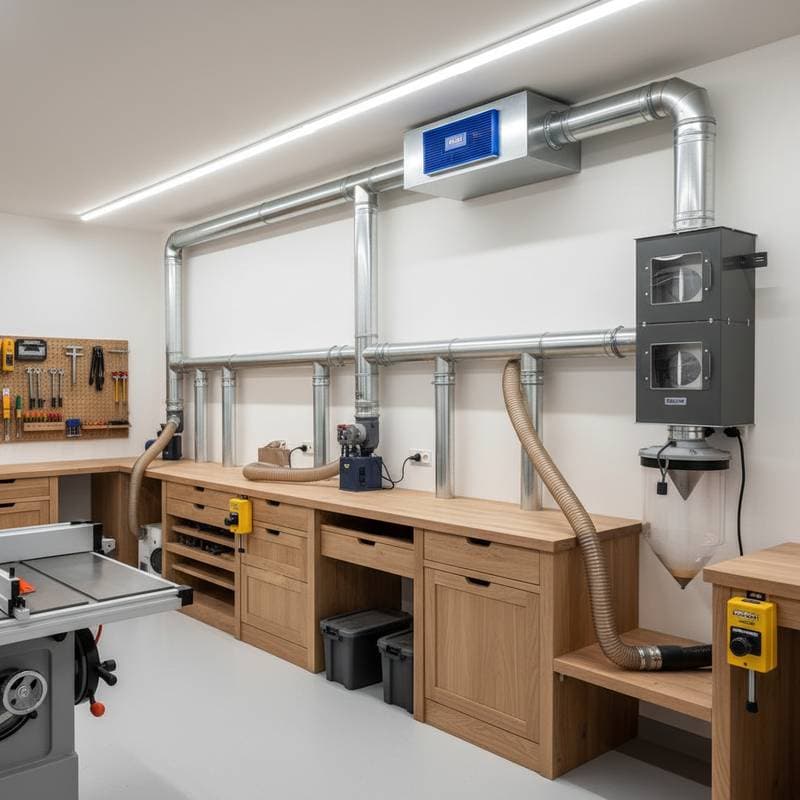
Integrated Dust Collection for Superior Workshop Air Quality
Woodworking generates fine dust particles that permeate the air during routine tasks like sanding or routing. These particles settle on tools, compromise finish quality, and pose health risks with prolonged exposure. Beyond basic vacuums, integrated dust collection systems provide consistent air purification essential for dedicated woodworkers.
This guide details the process of selecting, installing, and maintaining built-in dust collection setups. Readers gain insights into equipment choices, airflow calculations, and cost-effective strategies. The focus remains on practical improvements that enhance daily workshop operations without excessive complexity.
The Importance of Integrated Dust Collection
Wood dust includes respirable particles smaller than 10 microns, which remain suspended in the air and contribute to respiratory issues over time. Research from safety organizations highlights links between chronic exposure and reduced lung function, alongside irritation to mucous membranes. Integrated systems address these concerns by capturing dust directly at the tool source.
Portable vacuums handle larger debris but fall short on fine particulate capture due to limited airflow. Effective built-in systems deliver 350 to 450 cubic feet per minute (CFM) per tool, aligning with industry standards for containment. This capability results in reduced visible haze and improved overall air quality.
Action Step: Assess each tool's dust output by consulting manufacturer specifications. Calculate total required CFM by summing individual needs, then select a system with 10 to 20 percent additional capacity to account for duct losses.
Selecting an Appropriate Dust Collector
Dust collectors vary in design, influencing their suitability for different workshop sizes and budgets. Understanding these options ensures a match with specific operational demands.
- Single-stage collectors, priced from $300 to $700, employ a single impeller to draw air through a filter bag that captures heavier chips. These units work well in compact spaces operating one or two tools at a time.
- Two-stage cyclone systems, costing $850 to $2,500, use centrifugal force in a conical separator to remove debris before filtration. This design minimizes filter clogging and supports longer operational periods.
- Advanced cartridge-filter cyclones with HEPA media, beginning at $3,000 and reaching $6,500 for expansive setups, trap particles as small as 0.3 microns while sustaining high airflow rates.
Pro Tip: Opt for a 1.5-horsepower unit in shops under 300 square feet; scale to 3 horsepower or higher for setups with multiple simultaneous tools. Verify electrical compatibility, ensuring a dedicated 20- or 30-amp circuit to prevent overloads.
Optimizing Filters, Ventilation, and Air Return
Primary collectors manage bulk dust, yet ultrafine particles require supplementary measures for comprehensive control. Pleated cartridge filters rated at 99 percent efficiency for 1-micron particles form the core of effective setups. Schedule monthly maintenance using compressed air pulses at 90 pounds per square inch to restore optimal performance without damage.
Outdoor venting demands a backdraft damper to block reverse airflow, pests, and temperature fluctuations. For recirculating designs, integrate a standalone air cleaner capable of processing the full shop volume four times per hour. A 400-square-foot space, for instance, benefits from a unit rated at 1,200 CFM to maintain low particle concentrations.
Why it works: Source extraction paired with ambient cleaning reduces inhalable dust by more than 90 percent, as verified through particle monitoring protocols. This layered approach sustains a healthier environment throughout extended work sessions.
Installation: DIY Versus Professional Approaches
Small-scale installations suit hands-on woodworkers familiar with PVC piping and basic electrical tasks. Self-installation reduces expenses by up to 40 percent, though it requires precise measurements to avoid airflow restrictions.
DIY suits scenarios where:
- The workshop measures less than 500 square feet.
- Tools operate sequentially rather than concurrently.
- Existing wiring supports 20-amp loads without modifications.
Professional installation proves essential when:
- Multiple blast gates demand automated controls for efficiency.
- Ductwork involves lengths exceeding 25 feet or intricate bends.
- Compliance with HEPA standards or building codes requires certification.
Engage contractors with proven experience in HVAC and electrical systems, insisting on post-installation airflow verification via manometer testing. Target at least 90 percent of the system's rated CFM at each port to confirm efficacy.
Sustaining System Performance Through Maintenance
Regular upkeep transforms a dust collection investment into a dependable asset. Adhere to these protocols to extend equipment life and efficiency.
- Clear collection drums or bags when they reach 60 percent capacity to prevent overflow and maintain suction.
- Perform filter inspections and cleanings every four weeks, increasing frequency during intensive dust-generating activities like finish sanding.
- Apply dry silicone lubricant to blast gate mechanisms quarterly to ensure smooth operation.
- Examine flexible hoses and rigid ducts annually for wear, replacing sections that show abrasions or leaks.
- Conduct yearly airflow audits with an anemometer, adjusting as needed to counteract gradual declines.
Consistent maintenance yields tangible benefits, including diminished static electricity on workpieces and superior surface finishes. Reduced dust also eases motor workloads, lowering noise levels and operational costs over time.
Implementing Your Dust Control Plan
Begin by mapping your shop layout to identify tool locations and optimal duct routing. Source components from reputable suppliers, prioritizing quiet-operation models to minimize disruptions. Test the full system upon completion, monitoring air clarity during a simulated workday to fine-tune adjustments. With these steps, achieve a workshop that prioritizes health and productivity.