
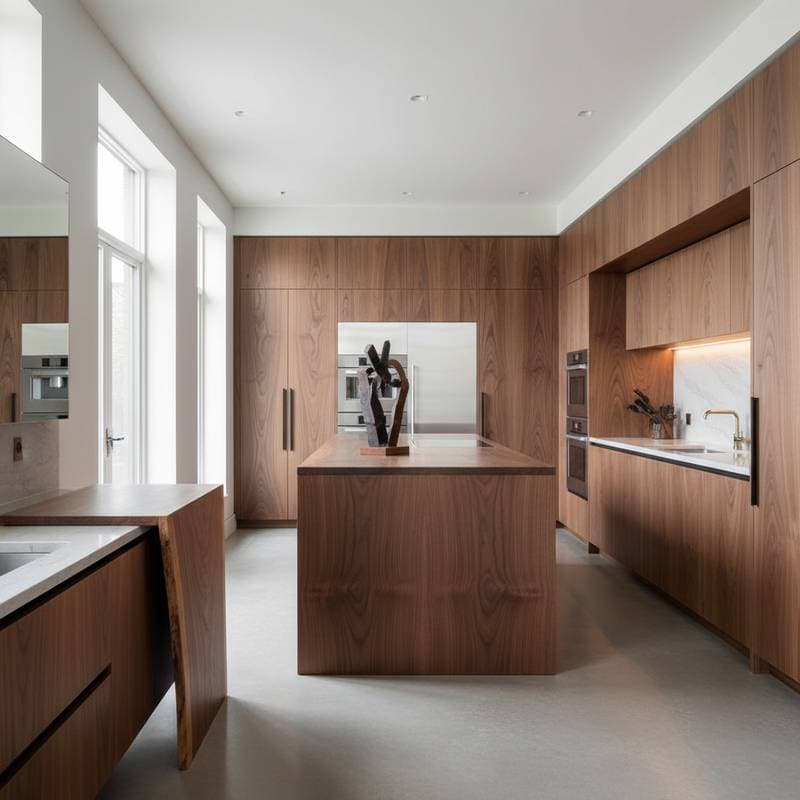
Walnut Waterfall Edges: 2025's Hottest Cabinet Trend
A walnut waterfall edge transforms a plain cabinet into a sculptural centerpiece. Homeowners request this feature in kitchens, bathrooms, and home offices. The design pairs warm walnut grain with seamless edges that flow down the sides like a sheet of water. When executed properly, it adds luxury without ostentation. The joinery, grain matching, and finishing require substantial skill. This section examines why this detail leads cabinet design, the associated costs, and methods to achieve excellence.
Why Walnut Waterfall Edges Are Surging in Popularity
A waterfall edge employs continuous grain that extends from the top surface down the vertical sides of a cabinet or island. The joint forms a 45-degree miter, which is glued and clamped to create the appearance of grain folding over the corner. Walnut emerges as the preferred material due to its straight grain and deep chocolate tones, which render the transition natural and fluid.
Designers report that clients appreciate the visual calm this feature provides. The vertical grain alignment guides the eye downward, anchoring the space effectively. Walnut complements materials such as white quartz, brass accents, and matte black hardware. In open-concept homes, the design delineates the kitchen area without relying on bulky framing.
From a resale standpoint, real wood waterfall edges enhance perceived value. Appraisers observe that buyers link them to custom fabrication rather than prefabricated options. A precisely executed walnut waterfall can increase the perceived design value by $3,000 to $8,000 in a midrange kitchen remodel. This premium arises from the evident craftsmanship and timeless appeal.
Action step: When updating cabinetry, request samples of continuous-grain walnut veneer prior to commitment. Observing the grain flow across corners in person confirms suitability for the space.
Cost and Budget Planning
Walnut waterfall edges incur higher costs than standard cabinetry, yet the aesthetic and durability benefits justify the investment.
Typical Costs
- Material cost: $60 to $110 per square foot for solid walnut or premium walnut veneer panels.
- Fabrication cost: $120 to $250 per linear foot of edge, varying by shop rates and finish quality.
- Installation cost: $400 to $800 for a single island or cabinet run, encompassing precision fitting and adjustments.
For a medium-sized kitchen island with two waterfall sides, fabrication and installation may total $2,000 to $4,000, excluding base cabinetry. Employing solid walnut throughout elevates the full project to $8,000 to $12,000.
Budget Tips
- Opt for veneer panels over plywood cores to enhance stability while reducing expenses.
- Restrict waterfall sides to prominent elements, such as an island or bar area.
- Integrate with painted cabinetry in other areas to maintain budget equilibrium.
Where not to cut corners: Steer clear of thin veneers or mismatched grain, as these flaws become immediately apparent and compromise joint integrity.
Action step: Solicit a detailed line-item estimate from the cabinetmaker, specifying miter fabrication, reinforcement hardware, and finishing costs. Such transparency mitigates unexpected overages.
Common Mistakes to Avoid
Even seasoned woodworkers encounter challenges with waterfall projects. Precision remains essential from initial preparation through final finishing.
Frequent Pitfalls
- Ignoring wood movement: Solid walnut expands and contracts with humidity fluctuations. Insufficient allowances lead to miter gaps.
- Poor grain matching: Minor discrepancies disrupt the continuity illusion.
- Uneven clamping: Excessive glue or pressure warps the seam.
- Using soft finishes: Low-durability oils fade rapidly on vertical surfaces.
- Skipping substrate prep: Veneered panels require flat, clean cores to preserve sharp miters.
How to Fix or Prevent
- Select quarter-sawn walnut or stabilized veneer to minimize movement.
- Perform dry fits prior to gluing.
- Apply uniform clamp pressure and verify alignment using a square.
- Choose finishes suitable for kitchen or bath environments.
- Sand edges gently between coats to prevent finish accumulation.
Action step: Retain offcuts from panels to test stain absorption and finish sheen before full application.
Making It Your Own
Customization options allow personalization of a walnut waterfall edge while preserving its sculptural essence.
Creative Variations
- Live-edge waterfalls: Retain the natural curve of the walnut slab on one side for a rustic aesthetic.
- Contrasting inlays: Incorporate a narrow brass or maple strip at the junction of top and side panels.
- Floating design: Elevate the cabinet slightly from the floor with recessed lighting below for a contemporary impact.
- Two-tone finishes: Pair dark walnut with lighter ash to introduce visual depth.
These adaptations maintain the seamless edge while aligning with individual style. They facilitate integration into wider interior schemes, ensuring harmony.
Action step: Develop a digital rendering or cardboard mockup prior to final decisions. Visualizing proportions in the actual space ensures the waterfall integrates without overwhelming the area.
Next Steps for Your Project
A walnut waterfall edge merges craftsmanship with design precision. Although the cost appears substantial, the outcome frequently emerges as the room's most captivating element. Budget $2,000 to $4,000 for professional fabrication, allocate two to four days for production, and anticipate half that duration for installation.
Resources and Visual Aids
Consult local woodworkers for hands-on demonstrations. Review portfolio examples from reputable shops to inspire your vision. These steps position the project for success, delivering enduring elegance to the space.